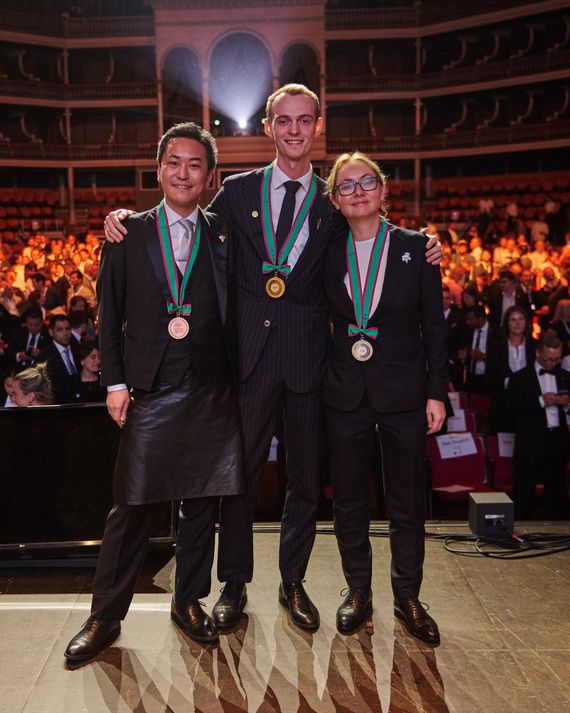
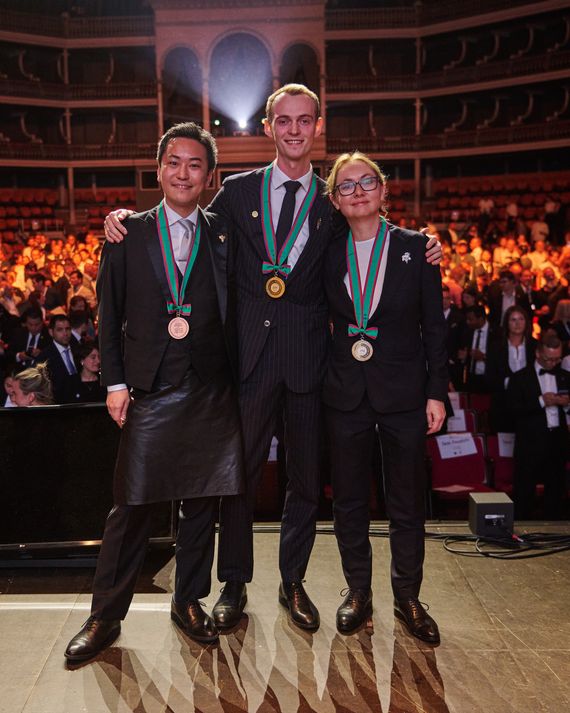
Pascaline Lepeltier, right, with the other finalists at this year’s Best Sommelier of the World competition. Photo: ASI
Late last week, Pascaline Lepeltier, the beverage director at the Tribeca restaurant Chambers, was pouring wine for an imaginary customer. She was competing in the World’s Best Sommelier event, put on every four years by the Association de la Sommellerie Internationale. The stage was set as a dining room, with wine professionals and judges filling the seats. Three finalists — Lepeltier, competing for France; Nikolai Haram Svorte from Norway; and Wataru Iwata from Japan — were put through a series of practical tests: pouring wine, decanting port, and, of course, blind tasting. Svorte suffered the wine-competition equivalent of a fumble at the one-yard line when one diner identified a wine he’d served as corked, meaning tainted by TCA, the musty, wet-cardboard compound that ruins a wine. “I am so sorry,” Svorte muttered. “It was under a screw cap, so I didn’t check.” (Cork is the usual culprit, but screw caps aren’t immune.)
Lepeltier was up second. (The MC announced, “Make him feel welcome,” although Lepeltier is one of the few women to compete within this world of high-caliber sommeliers.) She caught the corked wine before it had a chance to get to the judges’ table. As the contest continued, her deep knowledge of the wines she was tasting and serving, along with her command of the service itself, caused a woman behind me to predict, confidently, “she’s got this.”
Since the ASI began naming a best sommelier in the world in 1969, a woman has never won the competition or earned the title. The thinking going into this year was that Lepeltier represented the best possible chance of reversing that trend. When president William Wouters opened the envelope, there was an audible “Ugh.” He announced that Iwata had earned third place, and the audience held its breath. When he next announced that Svorte had won it all, an editor from Decanter turned to me, shaking her head: “How?”
I have known Lepeltier for almost 20 years (when she was 27, she was opening the now-defunct Rouge Tomate and crashing on my sofa; together, she wrote the introduction to my book, the Dirty Guide to Wine), so I was hardly an impartial audience member. But I was not alone in my shock. Laure Gasparotto, who writes about wine for Le Monde, understood what had been at stake: “Had Pascaline won this competition, it would have offered a real sense of hope to women,” she said. “Through her, the presence of all the women working in this deeply macho field would have been elevated to the podium.”
This was not Lepeltier’s first attempt — or her first disappointment. Sommelier competitions are solidly in the realm of the arcane, and they are as much about wine knowledge as they are wine service. Lepeltier started competing about a year after we met. In one early attempt to secure the title of top sommelier of France, she was the only woman. One task at a 2010 contest was to serve a magnum of Champagne, a big-boy bottle that Lepeltier poured perfectly nestled into her elbow, while the male competitors used two hands. While she passed that test but did not win the top award, she did collect irksome feedback from one of the judges: She was too enthusiastic, he told her. Perhaps, being a sommelier wasn’t her thing, the suggestions continued. If she were to insist on pursuing this career, she should wear “un petit talon” (a little heel) and some makeup.
Lepeltier, a former tennis player and philosophy student, was undeterred and returned to win the competition in 2018. She wasn’t wearing heels, petite or otherwise, when she became the first woman ever named France’s best sommelier. From there, she moved ahead to be the country’s candidate for the Best of the World. In 2023, at the Paris La Défense Arena, before a crowd of more than 4,000 people, she came in fourth, one place shy of the final. As she left the stage, the crowd screamed. There were tears and cries of “Pascaline!”
Not that it affected Lepeltier’s profile. She is well known among New York’s wine lovers and throughout wine circles in the USA and has become an out and out celebrity in France, covered in Vogue, Elle, Le Monde, and Philosophie Magazin. Try to extract her after a wine tasting in France and you’d think she was the Dalai Lama. I asked her a while ago why she’d keep subjecting herself to a formal competition that has little to do with the pleasure of wine and — with its emphasis on three-star dining and blind tasting — reinforces the belief that wine is for the elite and not something to be enjoyed by everyone. “I want to do it for women,” she told me. (When the New York Times broke the story of the “sexual harassment problem” within the American-based Court of Master Sommeliers, Pascaline was the first woman to give back her pin.)
The competition demands an encyclopedic memory, technical precision, and the ability to identify wines blind. Lepeltier returned to training: meditation, theater exercises, more study, travel, and, most important, blind tasting. She was determined, if not to win, to at least to get on that stage as one of the three finalists. The day before the show, 66 potential candidates had been whittled down to 20, after practical tastings and written exams that included questions about esoteric grapes and regions — and which wine Taylor Swift made famous (Sancerre). Then the trials began in fluorescent-lit rooms at a Sheraton: On a table were three glasses of wine, two sparkling and one still. Sommeliers had to identify how they were made. Next came a red wine. During her turn, Lepeltier leaned in, looking at the glass with a praying mantis’s posture. She had four minutes for an organoleptic description, then had to guess where it came from. “Syrah from Santa Barbara,” she said, locating the wine, a Tablas Creek Syrah, just an hour or so’s drive from where it had been made.
When, the next day, the show began in earnest, the 66 candidates marched to the stage, the five women herded together in the rear. The applause that roared when Lepeltier was named among the three finalists was as thunderous as the gasps that went up when Svorte was eventually named the winner.
Later, sitting on the balcony of the Lisbon Airbnb, with the burning meat from the downstairs restaurant perfuming the air, I asked Lepeltier whether she thought she still had to do this for women. She said she kept thinking of a quote she saw on the Instagram account of the Swiss winemaker Marie-Thérèse Chappaz: “To be feminist is not to follow the example of men’s success.” Then she took a sip of Champagne.