To love the pub is to lament the pub. It’s never as good as it was. Kingsley Amis, the greatest of the 20th-century British drunks, decried its decline back in the ’70s, when he seized “a long-sought chance to deliver a short, grouchy blast against what has been done, and what is still being done, to that deeply, traditionally British drinking centre.” The pub “is fast becoming uninhabitable,” he groused, carving out the usual exception: his own local. As for the others, they were an “ordeal” to be endured, what with their top-20 music, their trendy décor, and their “frequently appalling” food, “though I suppose,” he added for good measure, “one should be glad to see it there at all.”
With those criteria, what would Amis make of Dean’s, now open on Sixth Avenue, a self-styled “British pub in New York,” as carrier of Britannia’s torch? The décor is trendy (wood-paneled walls with maritime scenes) and the music (the evenings I went, a greatest hits of ’70s–’80s Brit post-punk, like A Certain Ratio and Siouxsie Sioux) almost certainly not to his taste, though very much to mine. And the food? The food’s great. That alone might be disqualifying.
Dean’s comes from Jess Shadbolt and Annie Shi of King next door. The two met at the River Café, whose Italy-by-way-of-cosmopolitan-London style inflected King’s, but in their follow-up projects, they’ve looked to their family histories. Shi opened Lei, a Chinese American experiment in unsticking the wine bar from its usual European axis. Now Shadbolt, raised in Suffolk on England’s southeastern coast, has Dean’s. Suffolk, where she keeps a little beachside fishing hut, is “a very important place for me,” Shadbolt told the Telegraph in 2024. “It has been the backdrop to all of my firsts; whether it’s my first kiss on the beach or first shandy, and my first introduction to simple, delicious food.”
Dean’s pub spirit is probably best captured by the central role played by Guinness and Old Speckled Hen, pulled from keg, not cask, the finicky will note. The first barfly to 500 pints will get his or her own engraved silver tankard, and you can get a shot of Guinness and a deep-cupped East Coast oyster. All this beer is a bit of a feint. Dean’s is a restaurant, and an ambitious one. It has a sizable menu, a very decent wine list, and a light, even manicured, touch.
The hanging rack of Walkers crisps that decorate the back bar of your average English pub has been replaced by five-buck bags of homemade parsnip crisps, and the “pork scratchings” — roasted batons of skin from the pig’s belly — are served standing tall like grissini. (King is known for its cracker-crisp grilled carta di musica; these scratchings are the longitudinal equivalent of Shadbolt’s latitudinal flatbreads.) Sir Kingsley would find cause to complain, I have no doubt. I couldn’t. Those scratchings are tooth-crackingly fabulous, served with an “orchard sauce” of Granny Smith apple and puréed quince, and the parsnip crisps good enough that I shoved the oil-stained bag into my pocket to finish later. I shuddered at the prospect of a Scotch quail egg — tiny orbs of pretension, never an improvement on their hen’s cousins — until I realized that Scotch eggs may be their perfect use-case, an excuse to tilt the greasy balance of these little heart attacks toward even more sausage.
A few of the menu items could have benefited from this spirit of mad abandon. The requisite plate of fish and chips was perfectly nice, hake fried a little darker than I’ve seen in the pubs of London and smaller than I’d expect at any of them, with fewer chips besides. A $28 appetizer of scallops and salsify was a polite hors d’oeuvre: two individual scallops served on their shells. Better to stumble toward “drunken gravlax,” juniper-scented petals of salmon pinking like dogwood blossoms, improved (if only we all could be) by a gin cure.
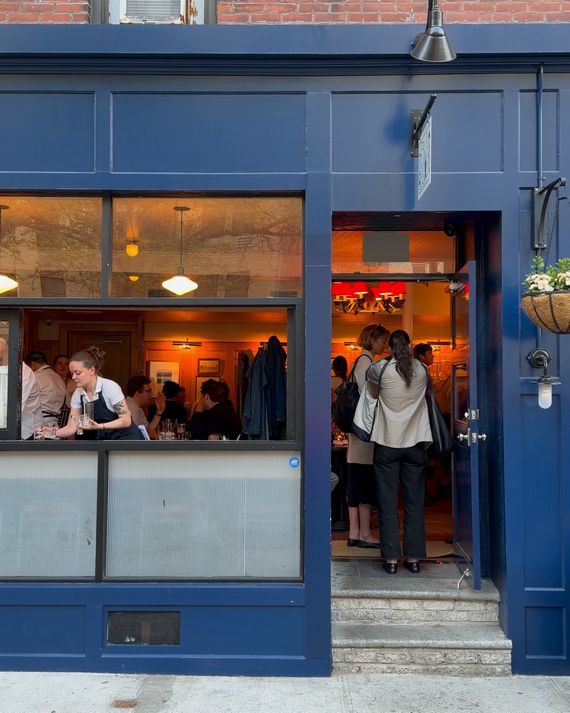
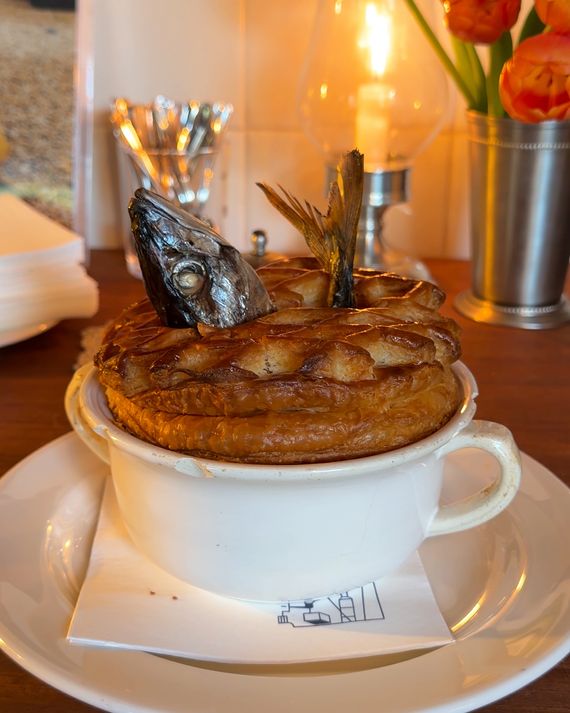
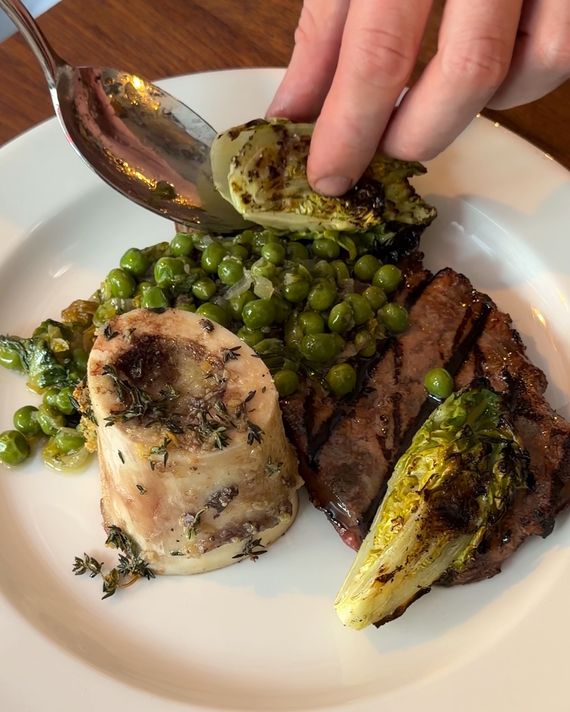
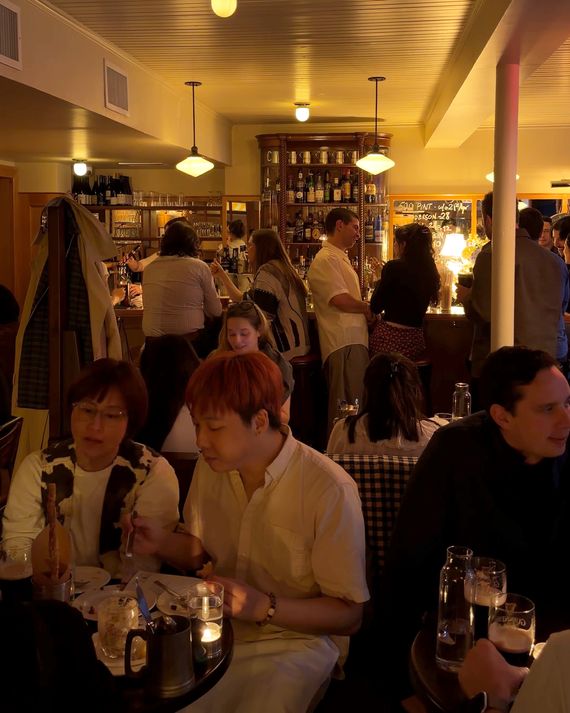
Dean’s has been designed to look like a pub; its crowd and food are unusually polished. Hugo Yu.
Dean’s has been designed to look like a pub; its crowd and food are unusually polished. Hugo Yu.
My advice: Go for what sounds the most British, even unappealingly British. The best thing I ate was a plate of what the house calls “boiled ham,” which qualifies as truth in advertising if not exactly genius in marketing. Justice for boiled ham, I say, thin, rosy, tender, and delicious, bathed in a creamy parsley sauce studded, when I had it, with the season’s first favas.
Sunday roasts will be introduced this summer, and lunch is soon to follow, as by pub custom it should. A riff on the classic “ploughman’s lunch,” here a plate of cheddar and cold roast beef, is already on the menu. As with so many hoary inheritances, this one is ersatz and adaptable. The ploughman’s lunch as a meal gestures at honest rural fueling; it was in reality popularized by cheese marketers in the 1960s. Like the entire pub genre, the legend is flexible, open to exaggeration, distortion, and embroidery. The ungenerous would call it a cock-and-bull story. Even that phrase is said to derive from the names of two local taverns, the Cock and the Bull. Like so many folk tales you hear in and about bars, this one, according to the OED, is bullshit. People still believe it: The authentic has no monopoly on the delicious.