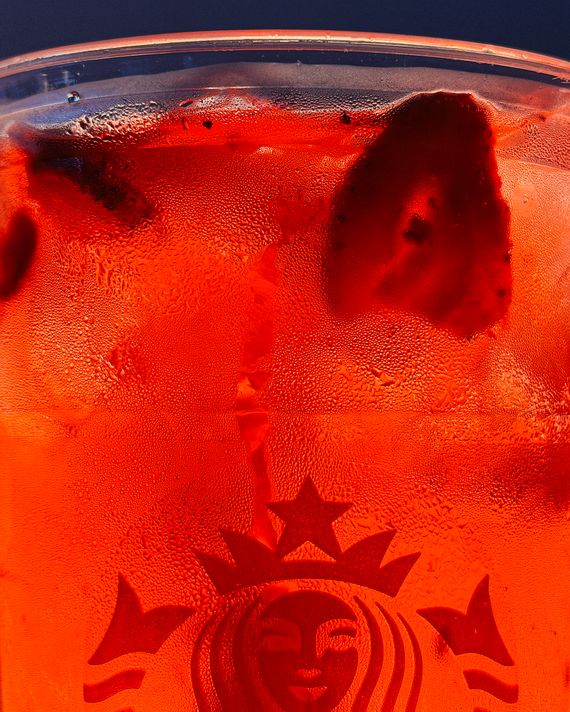
Photo: Jacob Moscovitch/New York Magazine
This article was featured in New York’s One Great Story newsletter. Sign up here.
At 3:30 p.m. on a recent Monday, inside the Starbucks on the corner of 66th and Amsterdam, backpacks and instrument cases were strewn across every available surface. The line to order stretched halfway through the store, and at the mobile-order pickup station, half a dozen translucent plastic cups glowed in shades of pink and purple, sweating gently, waiting to be claimed. Clusters of kids — girls, mostly — hovered near the pickup counter, heads bowed over one another’s phones. They came here in wide-legged jeans, miniskirts, baggy sweats, and crop tops; with bed heads and blowouts; in yoga pants, vintage tees, and so many different colors of Sambas. They are New York City’s teenagers, recently disgorged from nearby high schools, and for the rest of the afternoon, this Starbucks would belong to them.
Every seat was occupied: girls on boys’ laps, boys sipping Frappuccinos and watching basketball highlights, a few stray middle-aged people looking mildly uncomfortable to have found themselves inside a de facto student lounge. A girl in sweats scrolled through TikTok and nibbled at a croissant while waiting for a Strawberry Açai Lemonade Refresher, light ice, no strawberries. “I was just here two hours ago,” another customer announced to her friends.
Chloe, a 15-year-old relaxing with a venti Mocha Cookie Crumble Frappuccino on an oversize couch, told me she has “thousands” of Starbucks-drink photos on her phone. “It’s just … aesthetic,” she said. “It’s a thing.” Her friend Blanche — a self-described “chai girlie” — showed me a recent Instagram Story, a curated gallery of her past orders.
Jessie, a high-school senior, wrote her college essay about Starbucks. “Ever since high school started, I’ve been ordering a lot of Starbucks,” she explained. She started with Frappuccinos; when she became a junior, she raised her standards and switched to black coffee. Now, in her senior year, she’d arrived at a new equilibrium: “I realized I can achieve my goals without being so harsh on myself.” She smiled and took a sip of a purple Iced Ube Coconut Macchiato, new on the spring menu.
This particular Starbucks — a large corner location within spitting distance of multiple schools — is slammed with teens. But scenes like this play out in neighborhoods all around New York City and in cities and suburbs across the country. In recent years, cold, sweet, customizable drinks — Starbucks Refreshers, “dirty sodas,” boba teas, pastel matcha lattes — have become a core element of teenage consumer culture, right up there with Stanley cups, Korean skin-care routines, sneaker drops, and extended Fortnite sessions. In one recent consumer survey, half of Gen-Z respondents said they considered their favorite beverages to be “part of their personality.”
The trend has spawned a fleet of new chains (and new drinks at old chains) intended to lure the same audience. In New York, Blank Street, the fast-growing matcha and coffee brand, has become a magnet for teen girls; Cool Sips brought Utah-style dirty sodas to Manhattan with four locations and counting; and boba shops like Tiger Sugar, Gong Cha, and Boba Guys do healthy business among the too-young-to-vote crowd. Dunkin’ has been chasing the same teens with its own Frozen Matcha Lattes, Refreshers, and an ever-expanding menu of flavored iced drinks.
Nationally, growth has been explosive. Dutch Bros, a drive-through coffee chain best known for its extravagant iced drinks, has more than doubled its footprint in the past five years and now operates over 1,100 locations in 25 states with plans to nearly double again by 2029. Rival 7 Brew, with over 600 locations, saw its own sales more than double between 2023 and 2024. And Swig, the Utah-based chain that helped launch the dirty-soda category — drinks like Dr Pepper and Sprite doctored with syrups and coffee creamers — has expanded to roughly 120 locations across the South and Midwest.
Even fast-food chains and big soda are muscling in. Chick-fil-A opened Daybright, an experimental “beverage-forward” store outside Atlanta. PepsiCo is launching Dirty Mountain Dew in bottles, while McDonald’s and Taco Bell are both building out their beverage menus. “They see it as a way to connect with young consumers,” says Duane Stanford, the editor and publisher of the trade publication Beverage Digest.
Starbucks, for now, at least, remains the market leader. In Piper Sandler’s most recent “Taking Stock With Teens” survey, which polled over 6,000 American teenagers, Starbucks was the preferred beverage chain for over half of respondents. A spokesperson for Greenlight, a kids’-debit-card company that tracks spending across 6.5 million families, tells me the coffee chain is one of the top food merchants among its users. As my friend Jenny, a West Village mom of three, puts it, “a Starbucks cup is the must-have accessory” for tween and teen girls. Jenny’s 14-year-old daughter recently asked for $10 to give to a friend who was charging a fee to pick up Starbucks orders for the other girls on her school bus. “I’ve got to admire the entrepreneurship here,” she says, “but I told her this was a onetime thing.”
The ritual of teenagers bonding over sweet drinks is an age-old phenomenon, from the soda fountains of the 1940s and ’50s, to fountain Cokes at Sonic drive-ins, to the 7-Eleven Slurpee runs that, in my own youth, were a rite of passage for any kid with access to a car. Starbucks has taken this experience and turbocharged it.
The evolution started, ca. 1993, with the Frappuccino. As with penicillin and the microwave oven, this creamy coffee milkshake’s invention was an accident of history; a few rogue baristas in Southern California started blending coffee with ice, and customers loved it. At first, corporate resisted. “They thought it would compromise their authenticity,” says Bryant Simon, a history professor at Temple University whose 2009 book, Everything But the Coffee, uses Starbucks as a lens for understanding American culture. Eventually, however, the logic of formalizing the new drink was overwhelming; not only was its profit margin outstanding, but it handily covered up the taste of coffee, which opened the door wide to younger customers. From that point on, Simon says, teenagers gravitated to the stores. It helped that the brand was trusted by parents, and the company made the stores inviting to kids, hoping to hook lifelong customers.
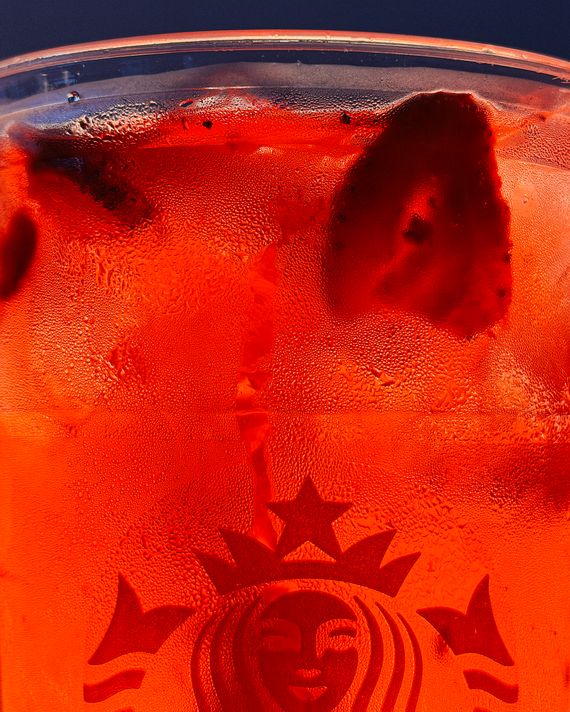
The quantum leap for Starbucks’ youth appeal came in 2012 when the company launched Refreshers: brightly colored iced drinks made with green-coffee extract. The drinks look and taste fruity with caffeine from unroasted arabica beans providing a mild buzz without any coffee flavor. This was Starbucks’ entry into what it now calls “the refreshment category,” coffee-adjacent products meant to spike afternoon business. It wasn’t long before people started customizing the Strawberry Açai Refresher by swapping the water for coconut milk. The result — a creamy, pastel-pink drink that photographed beautifully — spread across social media so fast that Starbucks added it to the official menu in 2017 and named it the Pink Drink. Today, Refreshers are a “$2 billion platform” for Starbucks.
The cold-drink shift has been seismic: In 2013, just 37 percent of beverages sold at U.S. Starbucks locations were cold; by 2021, that number was 75 percent. Today’s cold menu extends well beyond Frappuccinos and Refreshers. There is Nitro Cold Brew, iced shaken espressos, Cold Foam with flavors like lavender and salted caramel, and, launched this month, Energy Refreshers with customizable caffeine levels.
The company is careful about its messaging here — marketing caffeinated, sugary beverages to minors is sensitive work — but the youth-market appeal is undeniable. One recent addition to the Refreshers lineup is the Cannon Ball Drink, a neon-pink blend of Mango Dragonfruit and Strawberry Açai Refreshers with lemonade and fruit inclusions. It’s a collaboration with MrBeast.
I’ve tried many of these drinks, and I’m able to report that they taste … fine? They’re the beverage equivalent of a pleasant conversation with someone whose name you won’t remember. And yet the Strawberry Açai Lemonade Refresher and its ilk have captured the hearts and allowances of this city’s well-heeled teens. Why have these drinks struck such a chord? To find out, I spent two weeks staking out various Starbucks, Dunkin’, Blank Street, and Cool Sips locations as well as boba shops around New York during the after-school hours, pestering teenagers about their orders and observing the scene firsthand.
Ask tweens and teens what they love about these drinks and the answers tend to be — shocker — not terribly introspective. It’s a lot of “I like the taste” and “They’re refreshing.” The most obvious explanation I found for Starbucks’ sway with this age group is that its stores are just good places to hang out. Over and over, I watched kids huddled around phones with Refreshers, performing the ancient adolescent ritual of Doing Nothing Together. A $7 beverage was the price of admission. “It’s really the only food place we can sit down near here,” a high-school student named Ines told me while waiting for her own Refresher. “In the winter, this place is a lot warmer than the libraries.”
Like those totemic Labubus, a Starbucks drink also functions as a small affordable token of belonging. This helps explain the universal appeal of the Strawberry Açai Refresher; it is, according to all the Starbucks employees I spoke with, the most popular drink among teens despite tasting mostly like upscale Kool-Aid. “They flood in at 3:10 and order ten Strawberry Açai Lemonades in a row, all with different customizations,” a barista named Layla at an Upper East Side Starbucks tells me. “Light ice or no ice, no strawberries, and then if there’s one piece of strawberry, they get mad.”
Among adults, too, the appeal of Starbucks has always been as much about the brand as the products. Simon tells me that when he was researching his book on the chain in the early 2000s, he met a man who bought a Starbucks coffee on Monday and then brought coffee from home in the empty cup for the rest of the week. “You can’t carry your BMW everywhere, but you can carry your Starbucks cup,” Simon says. While the brand has lost that cachet for most adults, the badge value for teenagers has only intensified. “This signifies fun, that you have enough money to afford it, that you’re doing something that’s slightly illicit in a country that counts calories,” he says. The teens concur. “I think it’s an unspoken cool thing,” Brynn, 14, tells me. “When you have a Starbucks cup, people look up to you.”
That status comes at a price. An entry-level grande Pink Drink starts at north of $6; sized up or customized with Cold Foam, extra syrup, and nondairy milk, the price brushes up closer to $10. A twice-weekly Starbucks habit can easily run $50 or $60 per month, and many of the teens I talked to said they drained their allowances or babysitting savings to fund their visits. For many New York families, this is too much to spend for glorified soda, but for the teens who can swing it, or stretch to swing it, it’s the aspirational-splurge appeal that gives the drinks their status-defining power.
So does TikTok. Open the app and search #starbucks or #drinktok and you’ll be swallowed by an endless scroll of young women — usually in their cars, often with perfect nails — narrating their custom orders and filming their first sips. The drinks are purpose-built for this: the ASMR crunch of ice being shaken, the lurid pinks and purples, the satisfying swirl of Cold Foam settling on top. Starbucks knows this; the company has created a “Not-So-Secret Menu” broadcast channel on Instagram to share trending customer creations, and some of the most viral Starbucks drinks of the past year — the Gummy Shark Drink, the Cotton Candy Refresher, a Cherry Refresher that customers compared to a Capri Sun — were all invented by customers and spread on social media before the company officially acknowledged them.
Limited-edition cups or menu items keep the fire burning. Priscilla, 10, a Brooklyn native who is partial to a Dubai Pistachio Iced Latte, tells me she collects the limited-edition cups from Starbucks. “Me and my friend, we went to the Starbucks drive-through and asked if they had the teddy-bear cup, and they said they didn’t, so we screamed at the top of our lungs,” she tells me. “We did it twice, and the third time when we came around, they had a sign up: ‘No screaming.’” Her mother says the obsession started about a year ago: “All her friends at school love the drinks, plus she’s watching videos online.”
Starbucks’ drinks aren’t the only ones that photograph well, of course. Matcha has become its own aesthetic category on social media, and it’s driving more and more traffic to the relatively nascent, New York–born Blank Street. (The company has announced a massive new flagship location in Tribeca, which will move into a former Starbucks.) At a store on Madison and 88th on a recent Wednesday, tween girls in private-school kilts packed the tiny shop by 3:30, seemingly unbothered by the lack of seating; a store employee told me that the Daydream matcha, an ombré green-and-white iced drink made with matcha, oat milk, and a syrup of vanilla bean, honey, and cinnamon, was the best seller among that crowd.
A typical 16-ounce iced matcha latte, it’s worth noting, contains as much caffeine as a single shot of espresso. Chloe’s venti Mocha Cookie Crumble Frappuccino, meanwhile, delivers a 130-milligram jolt of caffeine, which is quite a bit higher than the 100-milligram daily allowance recommended for adolescents by the American Academy of Pediatrics. And though Refreshers look and taste like fruit juice — many parents don’t realize there’s any caffeine in them at all — they are made with green-coffee extract, which laces a grande drink with 50 milligrams of the stuff, about as much as a can of Diet Coke. (Daniella, 14, tells me that when her parents found out Refreshers were caffeinated, they temporarily took away her Starbucks privileges. “That lasted about two weeks,” she says.) Even still, the chain introduced a change to the Refreshers lineup this year, making the drinks’ caffeine levels fully customizable, from zero to latte-strength.
More parents might be concerned about the sugar factor. Perhaps surprisingly, most of the drinks I saw New York teenagers ordering were not the nutritional nightmares that periodically make headlines. A tall (12-ounce) Strawberry Açai Lemonade Refresher has about 24 grams of sugar; a grande Pink Drink, 25 grams. For context, 12 ounces of 100 percent apple juice — the stuff in every elementary-school lunch box — contains roughly 36 grams, and OJ clocks in at around 30 grams. Blank Street doesn’t publish its nutrition data, but I tried that vaunted Daydream matcha as well as a Strawberry Shortcake matcha, and they’re only mildly sweet — more grassy and oat-y than sugary.
That said, some of the chains blowing up nationally are a different story. Dirty sodas — the creamed-up, syrup-spiked fountain drinks that emerged from Utah’s Mormon culture — went viral on TikTok after The Secret Lives of Mormon Wives became Hulu’s most-watched unscripted season premiere of 2024; a medium dirty Dr Pepper at Swig packs over 90 grams of sugar and 400-plus calories into its 32-ounce cup; the largest dirty sodas can top 100 grams of sugar and 600 calories. Most of those chains haven’t arrived in New York yet, but Andrew Moger, the founder of Cool Sips, is betting they will — or at least that the appetite is already here.
Cool Sips, which opened its first Manhattan location at Rockefeller Center in April 2024, now has four outposts and plans for several more in 2027. The best seller is the Dirty Dirty, an homage to the original Utah-born dirty soda, but a store employee tells me the most popular drink with kids is the P-Town, an electric-blue mixture of Starry soda with blue-raspberry and watermelon syrups that tastes like 12 ounces of liquified Jolly Ranchers. “We really haven’t had our viral moment yet,” Moger explains, “but we know it’s a matter of time before we’re seeing more recognition across TikTok, which is really what drives teens.” He thinks one of his company’s new spring drinks, the Mango Matcha Sip, has that viral potential.
Moger has two teenagers of his own, and at home he rigged up a little Cool Sips test kitchen: a soda fountain with all the sodas and syrups and juices where they can bring their friends, test new flavors, and invent their own drinks. Now 17 and 19, they’re a little past the age where they go totally nuts for the opportunity, Moger says. “Early teens and tweens, it would have been all the rage,” he tells me. “But they still do it. And, of course, they put it on social.”