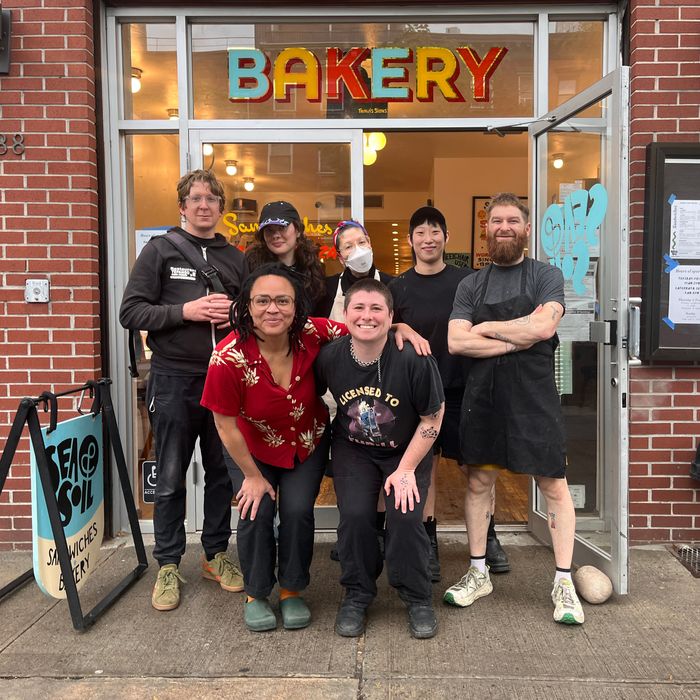
The worker-owners of Sea & Soil, including Noah Wolf (far right) and Gabby Gignoux-Wolfsohn (front right). Photo: Courtesy of Sea & Soil
The Zip Code 11217 is among the most expensive, highest-earning pockets of New York City, and the stretch of Atlantic Avenue that runs through it is predictably filled with indie fashion boutiques, vintage-furniture stores, gleaming Pilates studios, and Barclays Center. It is not, on first glance, where someone in search of some lunch would expect to find a worker-owned co-op where customers can choose what they pay for a smoked trout on some house-made focaccia.
Yet this is where founders Gabby Gignoux-Wolfsohn and Noah Wolf opened Sea & Soil last month. The two met a few years ago and worked together at a food pantry at the Center for Family Life, a social-services organization in Sunset Park. They started Sea & Soil at the Parkside Avenue Q stop, selling sandwiches off of a folding table by the Lincoln Road and Ocean Avenue entrance to Prospect Park during the first summer of the pandemic. It wasn’t a COVID-inspired lark. Wolf had worked as a baker in Los Angeles and wanted to do something of his own. “I had always been like, If I’m going to do a food thing, it has to be sandwiches,” he says, “and it has to be worker owned.” Gignoux-Wolfsohn was onboard with at least half of that sentiment: “I didn’t care what it was — I had just always wanted to start a worker-owned business.”
Eventually they worked their way up to the Grand Army Plaza Greenmarket, where they could sell 100 sandwiches during busy days and develop a base of regulars. They were able to upgraded, again, to a small space in Carroll Gardens through a combination of GoFundMe, savings, and begging high-school friends for loans. The latest move, to Atlantic, came after they received a $400,000 loan from the Working World, an organization that invests in and provides loans for worker-owned co-operatives. “My thought was, Maybe when we open, we’ll be 30 percent busier than our old shop, just as a kind of proof of concept to the Working World that this is gonna work out, even if it takes us a while to get there,” Wolf says. “But we’re easily 150 percent busier.” The staff now comprises three worker-owners and seven worker-owner candidates, who are given the option to buy a share of the business after working there for a year.
The narrow space is bright — hand-cut tiles line the wall above the bathroom, as do framed prints above the tables (made by the worker-owners during the renovation) — and big enough for the addition of an espresso machine, while the sandwiches on the menu (the Isaac, the Elliot) are named for worker-owners’ kids (except the Rafa, which is named for one worker’s dog). One customer eating an Elliot (roasted turkey with pickled jalapeños and fermented-cucumber sauce) was impressed with the store’s focaccia: “Very toothsome but also very moist.”
Even people who don’t know about the management structure won’t miss the sliding scale for payments: Customers are asked by cashiers how much they would like to pay (ranging between $13 and $24) and tap the screen accordingly. So far, Wolf and Gignoux-Wolfsohn both agreed that more people are buying on the high end than the low end with the average sandwich price hitting $16.40. If the steady flow of people keeps up, Wolf thinks they are on target to break even this year. (It can take years for some food businesses to become profitable.)
“I’m not conservative, but it’s a very liberal idea,” says Abram, a Bed-Stuy nail tech who was doing errands in the neighborhood recently and paid $17 for his sandwich. “If someone can’t afford $24, can they afford $13?”
It’s a fair question, but the model also has its early fans, like City Councilmember Lincoln Restler, whose office is down the block and calls it his “go-to” lunch spot: “Their sliding-scale prices, worker co-operative model, and warm vibes are a perfect fit in our community.” (When I asked how much he pays for his sandwiches, he declined to answer.)
Behind the scenes, business decisions — “financial, political, and ethical choices about how we exist in the world to smaller decisions like whether we should change an ingredient in a sandwich,” Wolf says — are made collaboratively, and an operating agreement requires that bigger decisions (like schedules, HR, shop policies, etc.) must be decided collectively. Joaquín, who works front of house, was drawn by the worker-owner pathway. “We are more horizontal and egalitarian. And how we solicit feedback from each other, and also how decisions are made, I like the dissolution of hierarchy in comparison to more traditional workplaces,” they explain. Ella, a back-of-house worker, agreed with the model: “People can see a transactional food space as a real way to make an alternative economy happen.”
The real test of any business, of course, is whether the food is good. In addition to the sandwiches, Sea & Soil sells pizza on Thursdays and Fridays and doughnuts on Sundays. It’s probably a promising sign that when I stopped in during a recent weekend morning, all the doughnuts had sold out by noon.
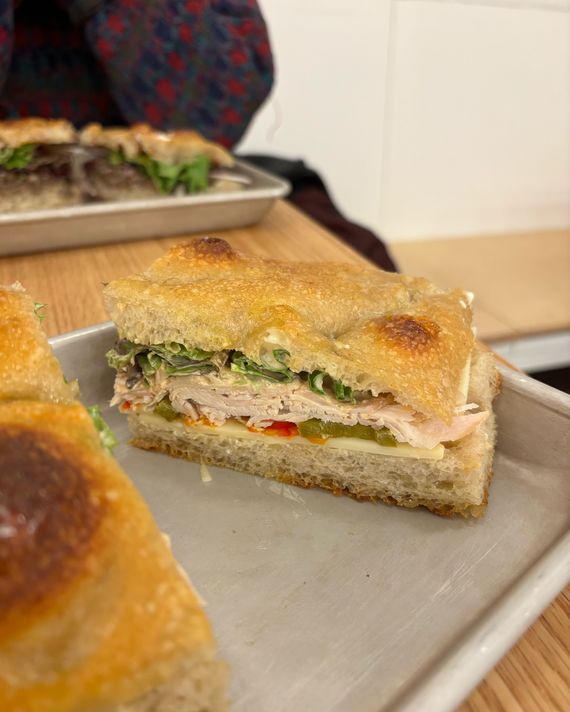
The Elliot, with roasted turkey, pickled peppers, cheddar cheese, and fermented-cucumber sauce. Photo: Elsie Carson-Holt