Fried chicken is not hard to come by at the many nouveau-country cafeterias around town — or anywhere else: My old Yemeni bodega in Brooklyn used to sell it by the piece at the counter. Unlimited fried chicken is a rarer bird. For that, you can head on down to Good Time Country Buffet, which looks airlifted not only from somewhere south of Marietta but also somewhen circa 1998. There, amid the steam trays of Salisbury steak, collard greens, baked beans, and candied yams, the partners behind the Korean restaurants C As in Charlie and Kisa have recreated the Atlanta-area southern buffets of their expatriate American youth, an exercise in memory that is an invitation to abundance. For $26.99 a head, the price of an appetizer at many fine restaurants around town, the only limit is your enthusiasm.
On a recent weekday evening, I dined there with two of the New York–iest New Yorkers of my acquaintance: one fresh off designing a top show at Fashion Week, the other coming from a party celebrating his latest triumph in alt-ceramics. These boys have hand tattoos and Comme des Garçons collections and blow off steam running 40 miles a week. And yet they’d gone goggle-eyed with joy at the prospect of hitting a suburban buffet. “You’re really not in New York anymore,” one of them said as we walked in the door, past the bulletin board’s tacked-up ersatz community notices that were set dressing in disguise. “You’re not even in New Jersey.”
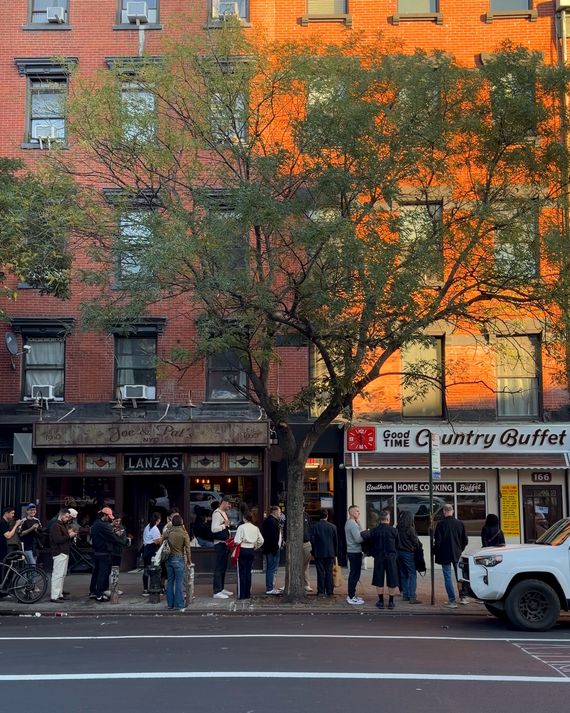
I grew up in ’90s Manhattan and never knew a real buffet like this. My nearest equivalent was the priced-per-pound steam table at the larger corner delis — which all somehow offered the same heterodox assortment of slicked lo mein and tomato-and-mozzarella caprese — and I have to admit I underestimated the pull this kind of establishment can exert. During Good Time’s first month in business, a line of eager pilgrims formed up First Avenue most days before the 5 p.m. opening. “It’s so funny that this is popular,” I overheard a girl say as she peered through the restaurant’s slatted blinds. “It does look cute,” her friend replied.
Good Time’s owners — David Yun, Steve Choi, and Yong Min Kim — mastered this kind of immersive scenography at Kisa, which is kitted out as a Seoul taxi drivers’ diner, accurate down to the boxy antique TV mounted on the wall. Here, Yun said, they wanted to incarnate the buffets, some of them Korean owned, that had set the scene for him when he immigrated to the U.S. in 2000. The décor is essential to the disorienting experience: the dowdy plush of green carpet, the grannyish wallpaper, faux Tiffany lamps. The music is an early-aughts Atlanta Honda Civic soundtrack: Akon, Usher, Lil Jon.
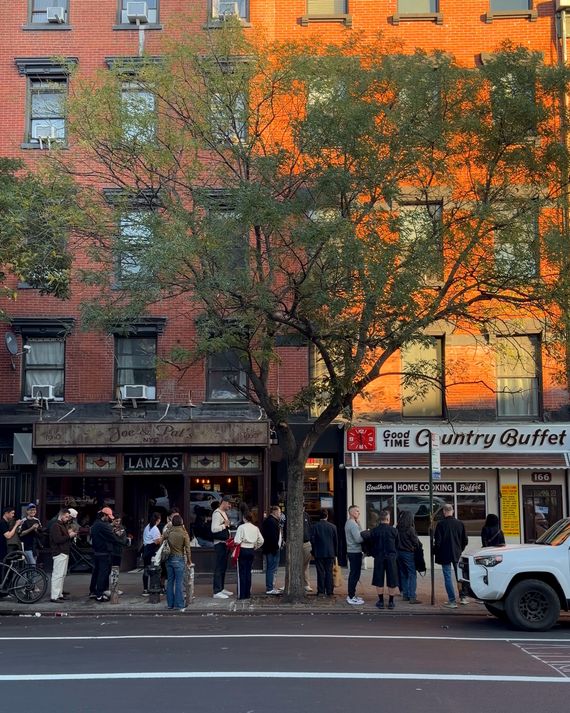
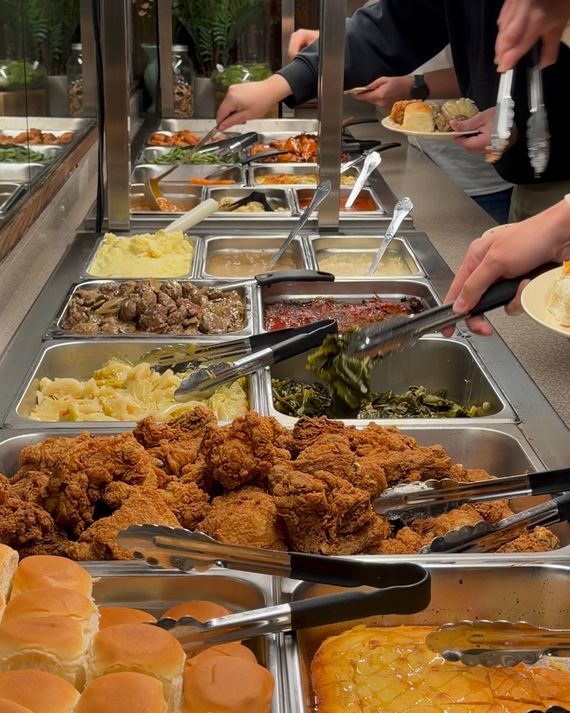
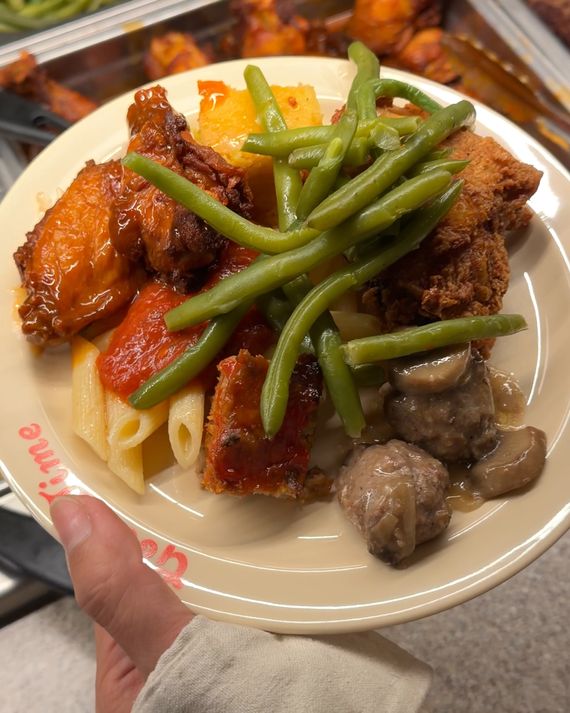
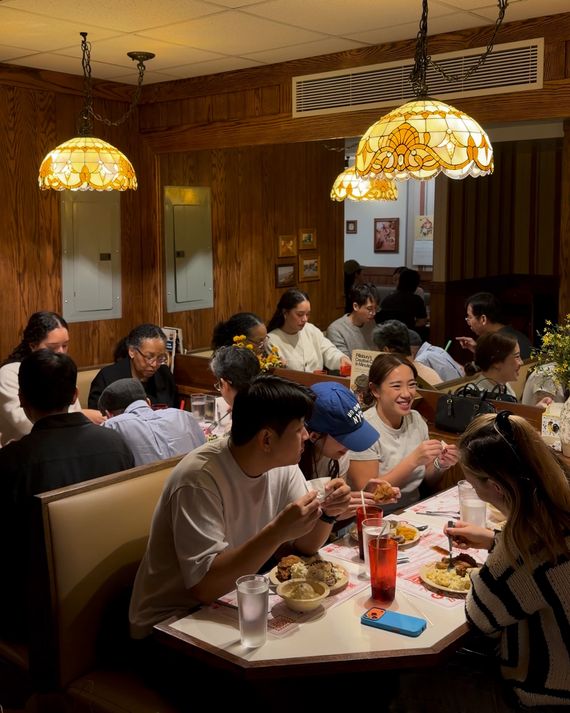
Lines outside form before the restaurant opens. Inside, the décor and food will be instantly familiar to anyone who’s visited a traditional buffet before. Hugo Yu.
Lines outside form before the restaurant opens. Inside, the décor and food will be instantly familiar to anyone who’s visited a traditional buffet bef… Lines outside form before the restaurant opens. Inside, the décor and food will be instantly familiar to anyone who’s visited a traditional buffet before. Hugo Yu.
The appeal cuts across communities — inside, I spotted a table of four elegant 50-something gentlemen across from a couple feeding an infant nibbles of Salisbury steak. Here an East Village beardo, there a rat-tailed gay guy. A middle-aged couple were pushing a grandmotherly woman in a wheelchair out the door, murmuring to her in Korean. She was beaming beatifically.
The aim of Good Time is a good time, which is not the same as good cooking. “We want to stick to the original recipes as much as possible,” Yun told me. “Nothing too out of the blue.” For edible set dressing, familiarity is the most important seasoning. The chicken is crunchy enough, though not especially tender; the meat loaf, sectioned into tiny squares, tastes of its caramelized ketchup top. Mashed potatoes, a few chunks intact, are dispensed using an extra-large ice-cream scoop with your choice of pale “brown” gravy or even paler sawmill gravy. Green beans are addictively overcooked; candied yams are diabetically sweet, though they hardly compare to the glycemic wallop of sweet tea. There’s a build-your-own salad bar, a potbellied tureen of chicken-noodle soup, and scoops of tuna or egg salad. Desserts are the most egregiously institutional. Yet I found my spoon going back for the thick, wafer-dotted gloop of banana pudding. It was more than I wanted and less than I wanted it to be, but it beckoned with an irresistible promise: There’s plenty where that came from.
Much of the food may be resolutely, even intentionally average — “Is it supposed to be bad?” my ceramicist wondered — but the ability to indulge without limits is its own reward. The buffet is id unlimited. “It’s about impulse,” the fashion designer said to me, loading up a plate of Red Hot–glossed chicken wings. He’d hoped they were gluten free. But he was prepared to risk it if they weren’t.
The insistent charm of Good Time doesn’t even really require firsthand history. There is, I’ve learned, a word for this borrowed nostalgia: anemoia, coined by the author John Koenig for his Dictionary of Obscure Sorrows. At Kisa, Yun said, “people always tell me, ‘Oh, this makes me feel like I’m in Korea back in the ’90s,’ although they’ve never been in Korea in the ’90s.” The past is a foreign country but one that you can visit — briefly. “I like to see these full plates,” a waiter said during another meal as he brought over slushy drinks — ready to be alcoholized by the upturning of a $7 single-serve nip of Evan Williams or Southern Comfort. Even with the encouragement to get multiples and a nimble staff clearing away half-empties, surrender can set in quickly. I did my worst and never lasted longer than 75 minutes.