Photo: Madilyn Bedsole
To millions of Netflix viewers around the world, Hasung Lee is better known as the Culinary Monster. That was the burly 37-year-old’s nom de guerre when he competed on the second season of Culinary Class Wars. Lee made it to the finals, where his technical precision lost to his opponent’s personal narrative, but more saliently, he made an impression as the series’ villain: garrulous, arrogant, and talented.
Only the last of those epithets is evident at his new restaurant, Oyatte, which opens this week. Occupying the bottom two floors of a Murray Hill townhouse — for years, home to shogun restaurant Kajitsu — Oyatte is Lee’s first restaurant. The 33-seat restaurant owes as much to his years at the French Laundry as it does to Atomix, which he helped open in 2018. “When I was at the French Laundry,” he explains, “I asked my friends what they thought of the name Oyatte. They said it sounded like an Asian restaurant. I asked my Korean friends and they said it sounded like a French restaurant. Perfect, I thought.” (Oyatte means plum blossom, the flower of the Joseon dynasty.)
Like the French Laundry, Oyatte is unapologetically luxurious. An eight-course tasting menu — which is really more like “15-plus courses,” according to Lee — runs $210 with a wine pairing for $170. Guests start the night with canapés in the downstairs lounge with walls covered with wood recovered from a barn on the property of Crown Daisy Farms, the Staatsburg property from which Lee gets most of his produce. (It’s owned by Brett Ellis, who is the former head farmer for the French Laundry, and Rebecca Ellis, the pastry chef at Stissing House.) “I wanted the guest to feel like they were in a cabin upstate,” Lee says. After six small courses, guests are led to an upstairs dining room. “I want them to feel as if they’re invited to my home,” he says, before noting, “but I live in Queens. This is too fancy for me.”
For being the work of a culinary monster, Oyatte is surprisingly understated and delicate. The menu’s spartan descriptions hardly hint at the complexity of each preparation. Many ingredients are left unenumerated and much of the work — which unfolds over three separate kitchens — is kept tucked away. “If they get it, they get it,” Lee says. “If they don’t, I hope they just enjoy their experience.” To help diners get it, Lee talked me through everything that goes into five of his first menu’s dishes.
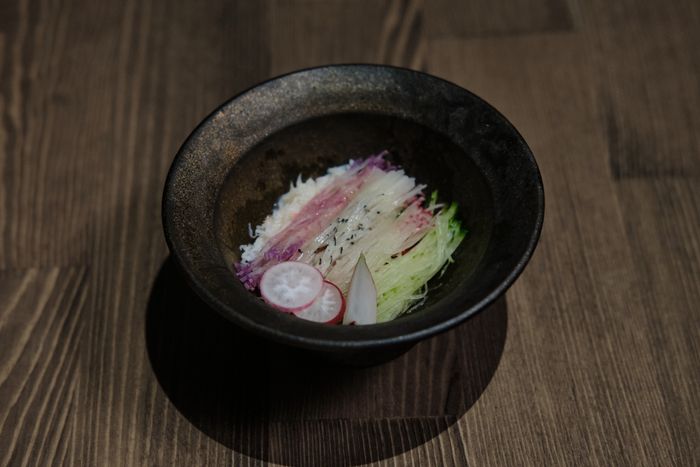
Photo: Madilyn Bedsole
The last of the six canapés, this is both a finale and a sort of palate cleanser. It relies on the subtle bitter spiciness of the radish in play with an entourage of accoutrement. Thin shreds of four different radishes sit on top of crème fraîche made with sake lees from Greenpoint’s Hana Makgeoli. “I’ve been using lees for fermentation for a long time,” Lee says. Beneath the crème fraîche is a marmalade made of radicchio, perilla leaves, balsamic vinegar, and apple juice; rhubarb preserved in pomegranate syrup; green strawberries poached and preserved in white wine. Chunks of Japanese snow crab sit around the crème fraîche. The dish is finished with dark maple-syrup vinaigrette and sea salt from Amagansett. “In every course,” Lee points out, “you can find small touches of fermentation and preservation.”
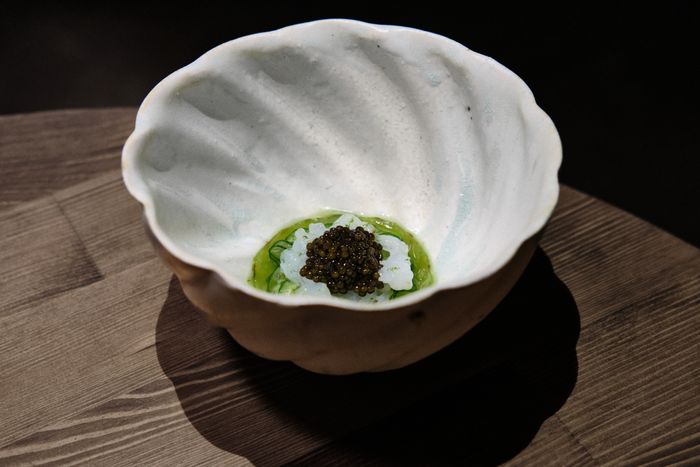
Photo: Madilyn Bedsole
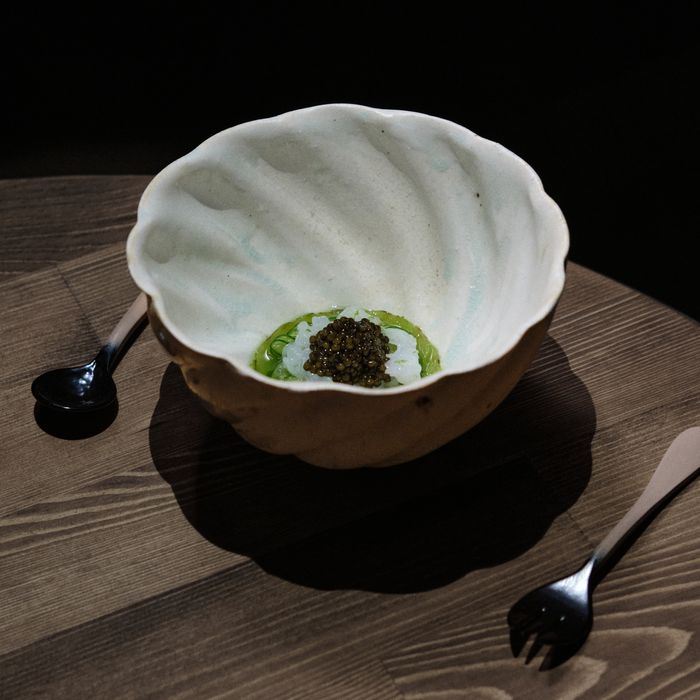
“I know cucumber season is a little bit too early to present,” admits Lee, but in this supplement he makes up for it in numbers. “We are using three different types of cucumber, presenting four different forms.” First, Lee makes a cucumber namul by salting and stir frying it in perilla oil. One cucumber is compressed in garlic-chive oil, charred and thinly sliced. The third cucumber is relish made of Kirby cucumbers, celery, onion, mustard seeds, salt, and vinegar. And the final form is a verge (a slightly bitter liquid) made of English cucumber and lime juice. This all sits on a mousse made of Maine eel, smoked in house, and Japanese bigfin reef squid from Japan, cured and thinly sliced. And then of course, the greenery is complemented by ten grams of jade-toned caviar.
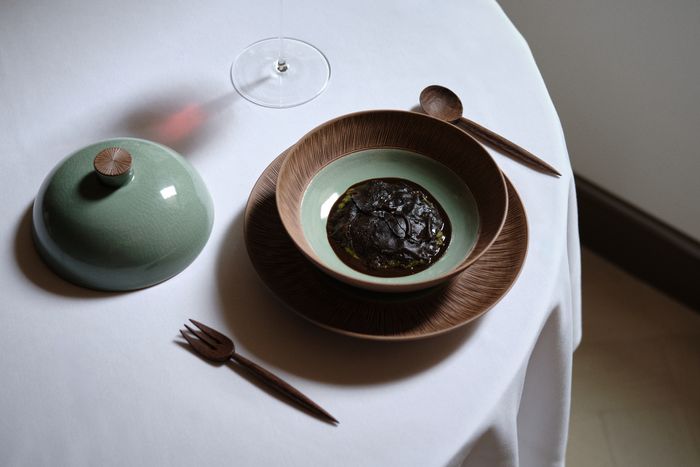
Photo: Madilyn Bedsole
For Culinary Class War heads, this green porridge is the stuff of legend. “This porridge is the very first dish I made and presented to chef Ahn Sung-Jae,” Lee explains. What first appears to be a glossy jet-black pillow is, in fact, a layer of thin-sliced black-truffle jangaji. The porridge itself, underneath its truffle blanket, is made of two different types of brown rice — a Korean variety called Saechybgmu, a single-origin rice from the Jirisan Mountain prized for its glutinous texture; and Golden Queen, which is more aromatic. The rice is cooked in a spring-green béchamel, using ramps, chrysanthemum, wild garlic, and Chinese chive and finished with a black-garlic gastrique. It is both Korean and not, which is exactly what Lee wants. “No one would call this hansik,” he says. “I used to work in California, New York, and in Denmark. I moved a lot. But I want to keep my roots and heritage as a chef.”
Bread served here with quail. Photo: Madilyn Bedsole
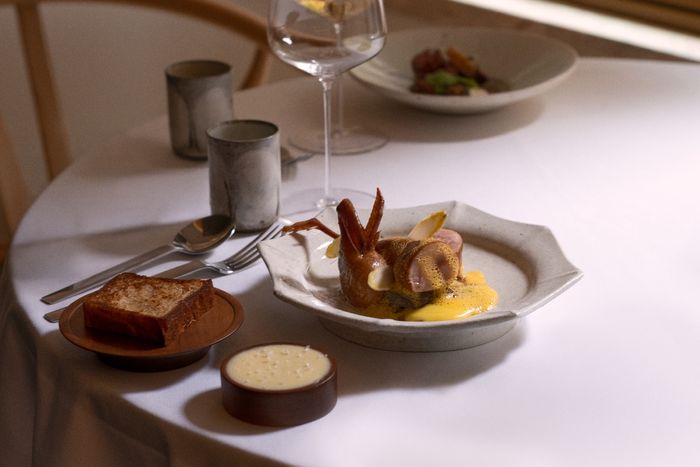
Many of Lee’s purveyors overlap with the French Laundry. The farmer, Brett Ellis, for instance, also supplies Keller’s flagship. The bread-and-butter course is no different. The butter comes from Animal Farm Creamery in Orwell, Vermont. “The previous owner, Diane St. Claire, had only six cows. One was named Keller.” Though now that count is up to ten, the dairy sells only to Per Se, the French Laundry, the Inn at Little Washington, and now, Oyatte. The rich-yellow cultured butter arrives with a slice of milk bread made in house. “We source our flour from Brooklyn Granary,” says Lee, “and use 40 percent red fife full grain and braised amber for texture and nuttiness.” Someday, he says, there will be sourdough, but “the starter has only been active for two months.” He says the kitchen is still testing it.
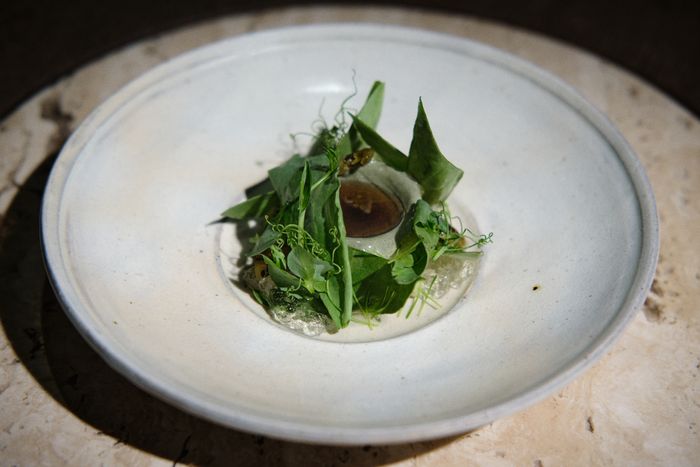
Photo: Madilyn Bedsole
“We have a course of light dessert and then heavy dessert,” Lee explains. The first dessert sits on a ridge between sweet and savory. The main components are an ice cream made from foraged mugwort (ssuk), meyer lemon gelée, fresh kiwi, and shards of kiwi jerky (kiwi, boiled in fresh kiwi juice then dried). The dark-green ice cream is topped with a pine-branch oil, which looks like an iridescent oil slick, black lime oil, and spruce tips. But, says Lee, the most important part are the fava shoots. “When Brett sent me the fava shoots, I thought, I want to do a salad. Then I thought, Why not highlight them as part of a refreshing dessert?”