After a summer of delays, Good Time Country Buffet is set to open in September. Photo: Scott Semler
A restaurant that celebrates the American South might seem like an unexpected follow-up from the restaurateurs behind C As in Charlie (a fusion of southern tapas and Korean bar food with “Seoul’sbury steak” and galbi jus) and Kisa (a perfect facsimile of a taxi-driver restaurant, or kisa sikdang, that flourished in Seoul in the 1980s), but all of the businesses are rooted in the owners’ collective biography. David Yun and Steve Choi met at Bethany Presbyterian Church in Georgia shortly after their families moved from Korea. “We wanted to really represent who we were, our own unique identity as Korean Americans who grew up in Atlanta,” Yun says. “Kisa was all about going back to our roots, to our childhood memories of local restaurants that we went to as young children in Seoul with our dads.” Now, with Good Time Country Buffet — which they’re opening with a third partner, Yong Min Kim — the group is revisiting their teenage years in early-aughts Atlanta, the era of Lil Jon, the Ying Yang Twins, and southern country buffets.
A country buffet — unlike a cafeteria, another southern institution — is a true serve-yourself, all-you-can-eat affair with a fixed price. At the time, in the late ’90s and early 2000s, the city was full of not only chains like Old Country Buffet, Hometown Buffet, Shoney’s, Golden Corral, and Sizzler, which enticed customers with endlessly replenishable chafing trays of fried chicken, collard greens, baked mushrooms, grilled salmon, and hush puppies, but — more saliently — smaller, independently owned buffets. Many of these were owned by Korean immigrants. “It’s one of those Korean businesses, like dry cleaners, deli, those kinds of things,” explains Yun. “We very naturally grew up on that concept.”
“Country buffet was a shocking experience just because you could eat chicken — as much as you wanted,” says Choi. “I used to overdo everything: grab four plates even though I already have two plates on the table.” When it opens in mid-September, after a summer of delays, Yun stresses, Good Time won’t be an homage to the country buffet. It will be a country buffet. “We just thought about what’s missing in New York,” he says. “First, something affordable is missing. Second, all you can eat is missing.”
For Yun, that nostalgia runs deep. He celebrated his birthdays with plates of fried chicken at places like Johnboy’s Home Cooking and Journey’s End. His father, an office worker in Seoul, had taken a job delivering vegetables to area buffets, so he spent his weekends tooling the country roads, familiarizing himself with load-in docks from Alpharetta to Marietta. When he got a little older, in fact, his first job was at a country buffet called Donnie’s Country Cookin’, run by a friend’s father. “He gave me this cashier job when I was, like, a sophomore in high school.”
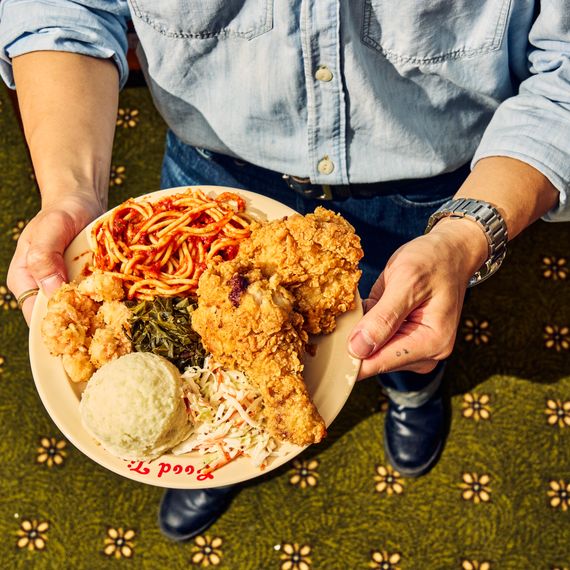
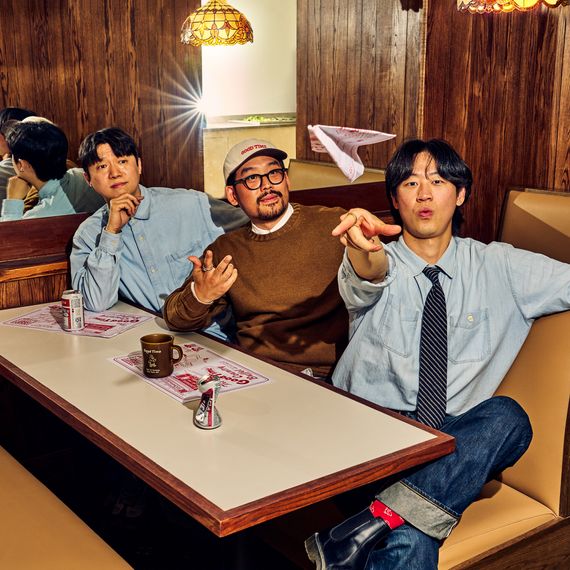
A perfect buffet plate; partners (from left) Yong Min Kim, David Yun, and Steve Choi. Scott Semler.
A perfect buffet plate; partners (from left) Yong Min Kim, David Yun, and Steve Choi. Scott Semler.
To that end, the new space has been made as painstakingly authentic as Kisa. “One thing that I’m very proud of is we’re going to use carpet here,” Yun says. “I don’t remember the last time I went to a restaurant that used carpet in New York, but when you step on carpet, it feels good.” Further, there is no wallpaper; there are wallpapers, multiple, as though an owner has had to replace sections piecemeal. Though the previous tenant, Ferns, boasted an elegant wooden ceiling, Yun and his partners have replaced it with the anodyne drop-ceiling tiles familiar from offices worldwide. “We went backwards,” he says, laughing.
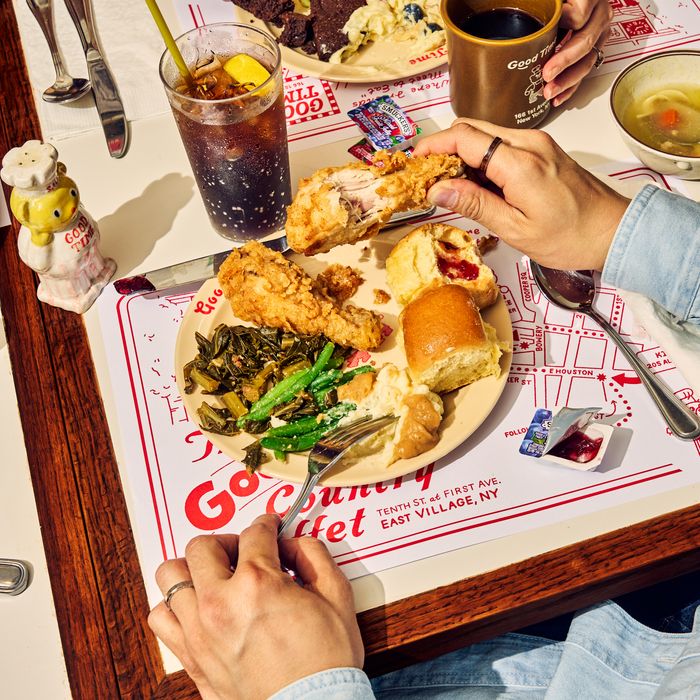
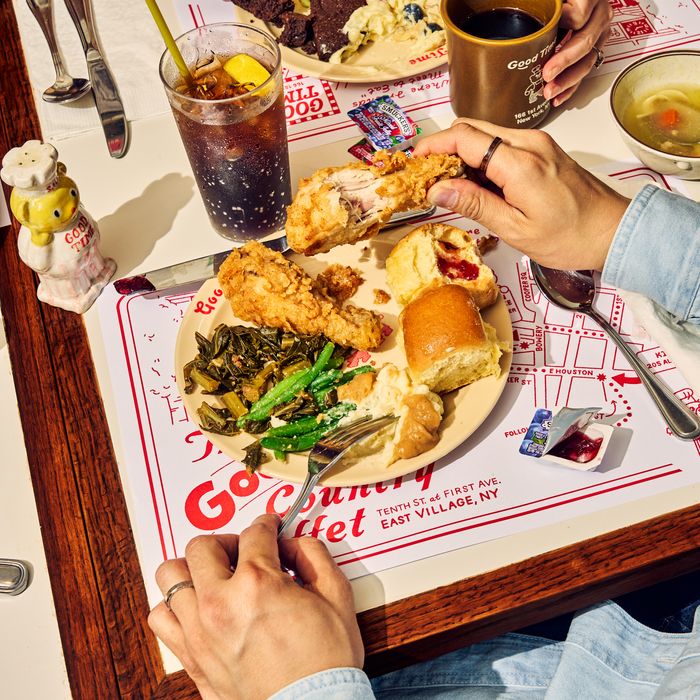
But of course, the appeal of the buffet is the buffet itself, and the titular buffet at Good Time occupies a large back room, about a third of the overall space. “Technically,” Yun explains, “we could feed 90 people, but we want it to keep the seating small and the food fresh.” The spread adheres to the mores of southern country-buffet tradition. From a subterranean kitchen, double-fried chicken, brined in buttermilk, emerges with its shatter skin. Rib tips, slowly simmered for three hours and tossed in homemade barbecue sauce, come out sticky and sweet. Collard greens braised in bacon-fortified chicken stock sit next to a golden tray of mac and cheese, a combination of cheddar, mozzarella, and American cheeses, folded in with heavy cream.
As in true southern-buffet fashion, specials will rotate on a regular basis. (Yun remembers how superannuated buffet aficionados planned their weekly circuits based on daily specials.) Monday might be for meatloaf and rib tips, fried green tomatoes, stuffing casserole, French fries, and chicken noodle soup. Thursdays could bring meatballs and fried shrimp, fried okra, green beans, hash browns, and chowder, with Saturdays and Sundays reserved for country ham and fried catfish, onion rings and hush puppies, grits and tomato soup.
For all of this, and all you can eat, they will charge $26.99 for adults and $13.99 for kids. Per buffet tradition, there will be a 10 percent discount for seniors. “We could charge more,” admits Yun, “but we want to keep this affordable.” Yet that simple goal — an affordable restaurant serving limitless food of reputable quality — seems, within New York’s current restaurant landscape, dicey. The profitability of flat-rate pricing, says Eric Chiang, a professor at University of Nevada Las Vegas who has studied the economics of all-you-can-eat buffets, depends on a subsect of users maximizing the system and some underutilizing it. “Buffets tend to be profitable,” Chiang says, “because though some people do try to get their money’s worth, usually when you go to a buffet, you go in a group, and not everyone is hungry.”
How will that play out in downtown Manhattan? Nobody’s quite sure. “It’s a risk,” Yun admits. “Our confidence comes from operating Kisa, which has a fixed menu and an affordable price. Here, once you’re seated, you don’t have to look at the menu. You don’t have to decide what you want to order. You just go grab a plate and get your food, and that’s it.” The model relies on endless food and quick turns. “We think this will be, maximum, about 75 minutes,” says Yun. That sounds nice, but then again, who would ever want to leave if they’re having a good time?