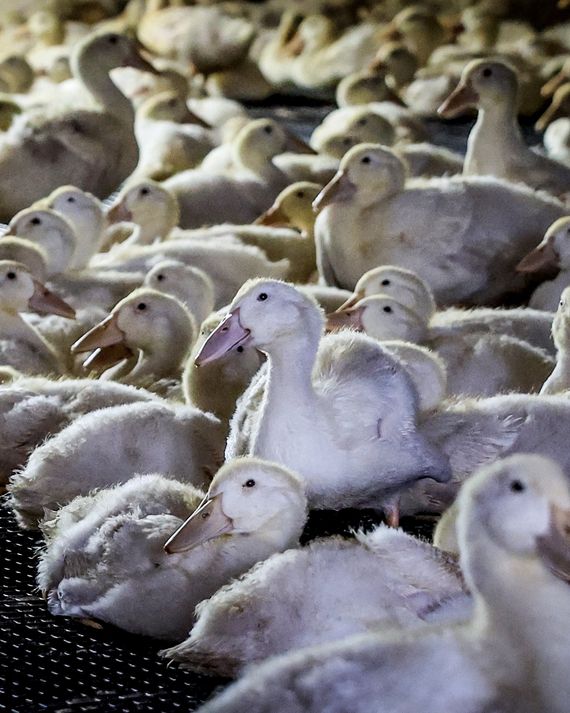
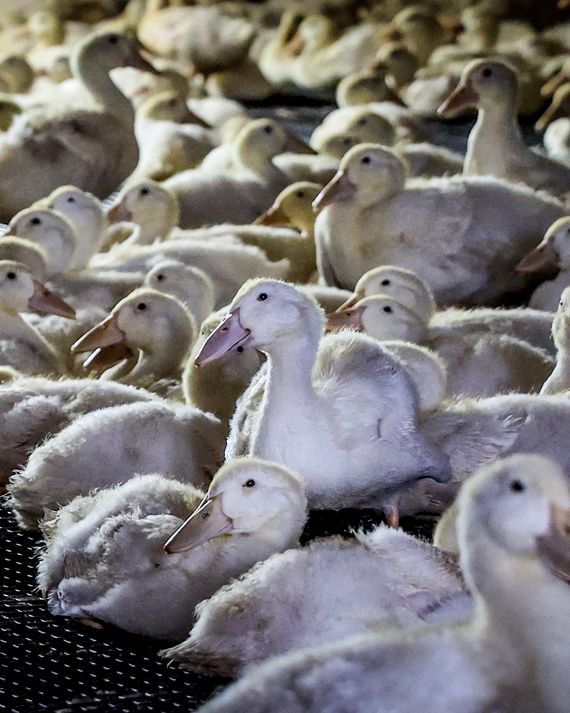
Doug Corwin’s ducks. Photo: Thomas A. Ferrara/Newsday RM/Getty Images
Doug Corwin, who runs the 118-year-old Crescent Duck Farm on the North Fork of Long Island, had a great end to his summer: After a bird-flu outbreak forced him to cease operations nearly two years ago, he was at last ready to get back to business and bring back more than three dozen former employees. “I hired 39 people,” he says. “Having them back, all trained and eager with smiles, was such a heartwarming thing.”
It’s a shock that Crescent reopened at all. In January 2025, Corwin discovered hundreds of two-week-old ducklings in one of the barns had fallen ill and died. He called Cornell’s Duck Research Laboratory to test the birds and braced for the worst. The next day, scientists confirmed that the ducklings had succumbed to avian influenza, a highly infectious disease that had been spreading swiftly through wildlife populations and dairy and poultry farms across the country. After reporting the outbreak, USDA officials told Corwin he would need to cull his entire flock of 100,000 ducks and quarantine the property indefinitely. Corwin feared he would have to close the farm, Long Island’s last commercial duck operation, which had been in his family for four generations. For chefs, that meant some of the best birds on the market might be gone for good: Crescent’s ducks were a special breed of Pekin. Corwin had spent years working to grow a succulent bird with larger, meatier breasts without sacrificing the thick layer of skin fat that imparted much of its flavor. “I remember David Bouley came out here and said, ‘Thank you,’” Corwin recalls. “Without the genetics over the years, there’s no way I can survive against the guys in Pennsylvania and Indiana with cheaper ducks.”
Cornell and state Agriculture and Markets officials knew how in demand Corwin’s ducks were with the restaurant industry and had an idea to save his business. They proposed segregating a batch of older, stored eggs, sanitizing them with chlorine, and removing them from the 140-acre farm to hatch off-site. A friend of Corwin’s ran a nearby turkey farm and allowed him to incubate the duck eggs in his unused barns while Cornell put another batch in its lab facility. It was, Corwin says, “a highly unusual” arrangement.
The eggs began to hatch in the third week of February as Corwin washed and fumigated 30 barns on his property. Three months after that, in the spring of 2025, the USDA tested the barns and removed the quarantine, allowing the ducks to return to Aquebogue. That generation started to reproduce that August, but Corwin needed to wait another half a year until his flock grew to 7,000 females to have enough birds to resume production. Today, he has 62 people working at the farm, which began taking orders last month from restaurants and specialty food distributors including Chefs’ Warehouse, D’Artagnan, and Pat LaFrieda. “I can see their orders getting bigger week by week,” Corwin says. The current flock is 70,000 birds, and he hopes to get back to 100,000 ducks soon.
Suffolk County chefs have migrated back as well. Eric Lomando, of the Italian spot Orto, served Crescent’s ducks for 25 years before he was forced to switch to a different breed that he found less consistent and tougher. He says Corwin’s ducks “have the best meat-to-bone-to-fat ratio.” The chef Francis Derby didn’t even bother putting duck on the menu at his North Fork destination, the Halyard, during Crescent’s 20-month hiatus. Now Derby, whose grandfather once ran a duck farm of his own, is preparing a different duck special nearly every week. Lately, he’s offered a roasted half-duckling with pommes frites. This month, he’s run a duck confit pasta with broccoli. “Doug has really refined those ducks to be very special,” Derby says. “I think they’re the best ducks out there.”