Why not Burmese? The country of Myanmar — widely known until 1989 by its colonial name, Burma — is larger than Thailand and more populous than South Korea, but its representation in city kitchens and dining rooms is next to none. You can find 100 pad see ews for every lahpet thoke, Myanmar’s fermented tea-leaf salad, in the five boroughs, though there are nearly as many Burmese and Burmese American people living here as Thai. Every few years, a Burmese restaurant does crop up and the critics swan in to swoon. The cuisine is so delicious that each one is a cause for celebration, as well as a testament to perseverance: Myanmar, in the grips of a military junta, has been ravaged by a murderous civil war for years and largely ignored by the world powers.
Burmese Bites is both the newest contender and an elder statesman of the scene, such as it is. In 2014, it graduated from a stand at Glendale’s Myanmar Baptist Church Fun Fair to a series of Manhattan pop-ups. From there, Burmese Bites made regular appearances at Queens Night Market and then within the food court at Elmhurst’s Queens Center mall. Its new location, just down the block from a Tiger Schulmann’s Martial Arts and a Banana Republic Factory store on 31st Avenue in Astoria, is a more permanent home.
The cooking that made the other locations so popular has made the move: that lahpet thoke, bright, crunchy cabbage leaves that go mulchy and rich when slicked with fermented green tea; thick curry of baby goat, with its dark, almost coffeelike bitter heat; the chicken curry that comes as a sidecar with a pile of postage-stamp-size palatas, the flaky, oily answer to India’s parathas; and mohinga, Myanmar’s national soup, a broth into which catfish dissolves to lend a mysterious and invisible richness to rice noodles with lemongrass and pepper.
Rebecca Nant runs the kitchen while her husband, Myo Lin Thway, oversees the dining room like a T-shirt clad ambassador, taking names, delivering dishes, spieling spiel. The restaurant’s ambition, printed on one of its streetfacing windows, is to share the taste of Burma with the world. So far, invitation accepted. When I arrived one sweaty September evening, a crowd of ten was milling outside, waiting to be summoned to its handful of tables. Inside, in barely appointed quarters — despite the cheerful yellow-and-purple accent walls, the décor still reads “food court” — families share platters of curry and rice next to people on dates, friendly twosomes. Over a few visits, I spotted a diner in a hijab a few tables away from a young guy in a Meg Stalter Oh, Mary! T-shirt a few tables away from a woman quietly eating alone with chopsticks (the Burmese, like the Thai, generally use their hands or a fork). The peafowl — Myanmar’s national bird, etched emojily onto the window — lured them all.
Thway understands that even in Queens, our most diverse borough, Burmese food could benefit from analogy and explanation, so when he recommends pat tote — chicken dumplings in beggar’s-purse wrappers, their hems frilling behind them, fixed in hard fry — he does so as Chinese dumplings done “our way.” That sells both short: They are smaller and funkier, meant to be dragged through a sweet, musky tamarind sauce.
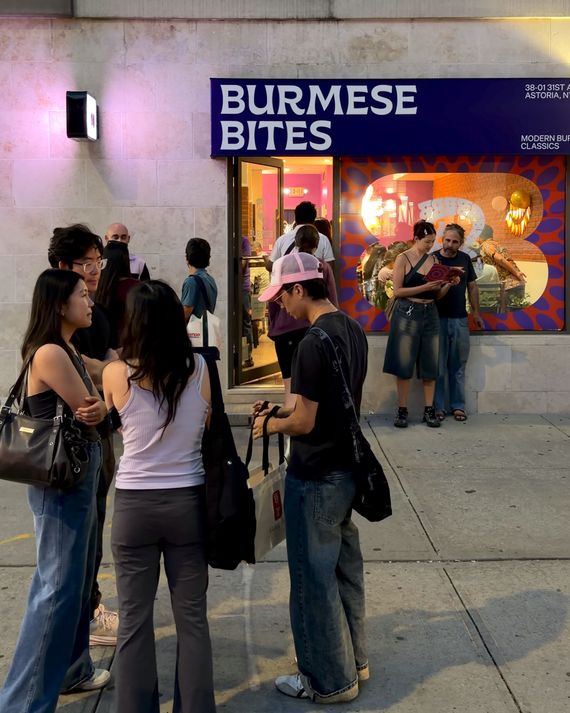
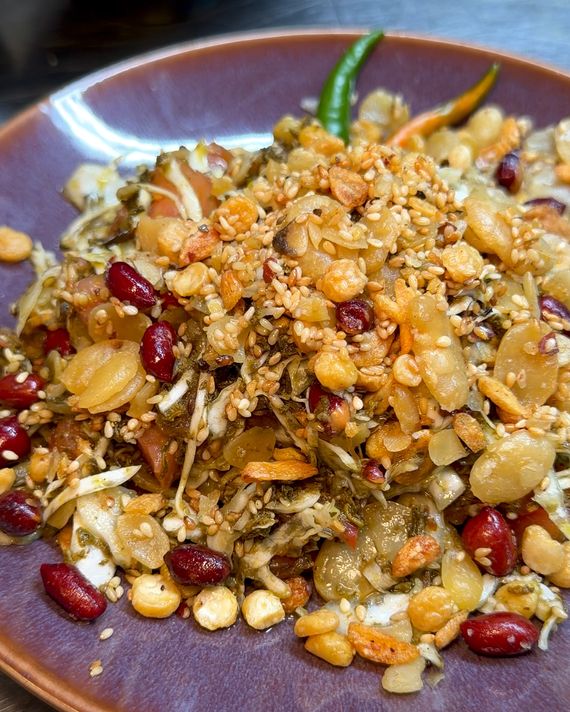
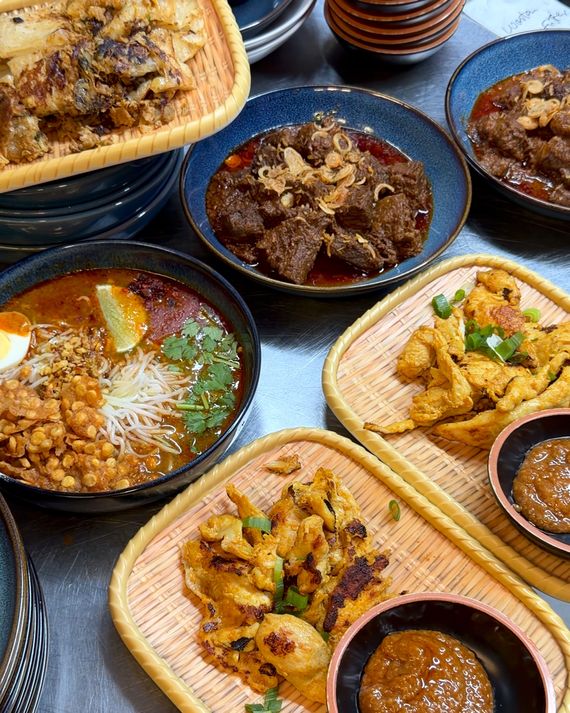
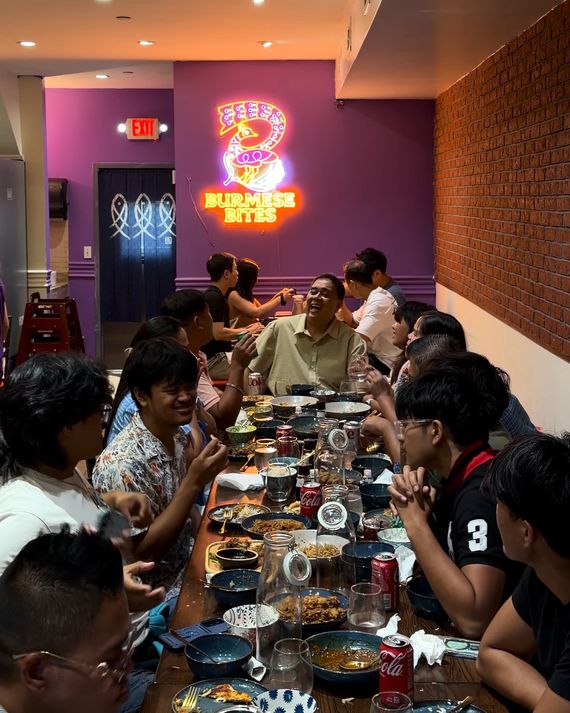
After years as a roving operation, Burmese Bites’ permanent restaurant opened this summer. Dishes include lahpet thoke (top-right). Hugo Yu.
After years as a roving operation, Burmese Bites’ permanent restaurant opened this summer. Dishes include lahpet thoke (top-right). Hugo Yu.
The menu lists nga hin, fish curry, as Thway’s favorite. “I don’t know what’s in it,” he says. “My wife makes it — I just take the credit.” It’s in a ruddy sauce redolent with garlic, more tamarind, and cilantro, a few green chiles scattered throughout. Those are extra spice, he explains, for the Burmese customers; not everyone can handle them.
I needed the heat, without which Burmese Bites’ dishes can occasionally lean mild. But with a jar of chile flakes and a cruet of fish sauce on every table, you can titrate the tingle and savor to your own preferred levels. No entrée is more than $27. Accessorize with a few fried bits of your choosing (a tangle of onions and squash or a platter of spring rolls filled with soft mashed potato) and a nonnegotiable tea-leaf salad, and you’ll leave for a song with barely any room for dessert.
Save space anyway. Shwe kyi is a traditional cake doused in coconut cream, which arrives deceptively square and stodgy-looking on the plate and melts when it hits your tongue into a confetti of sweet, steaming semolina. Or hold off fall’s arrival by ordering mont lat saung, a vivid, Easter-egg-colored bowl of sea-green pandan-and-rice-flour droplets (they taste like sweet, minty noodles) in icy palm-sugar-sweetened coconut milk, a cold dessert soup. If Burmese Bites takes off, a spinoff opportunity lies in wait: Next summer, Burmese Slurps!