
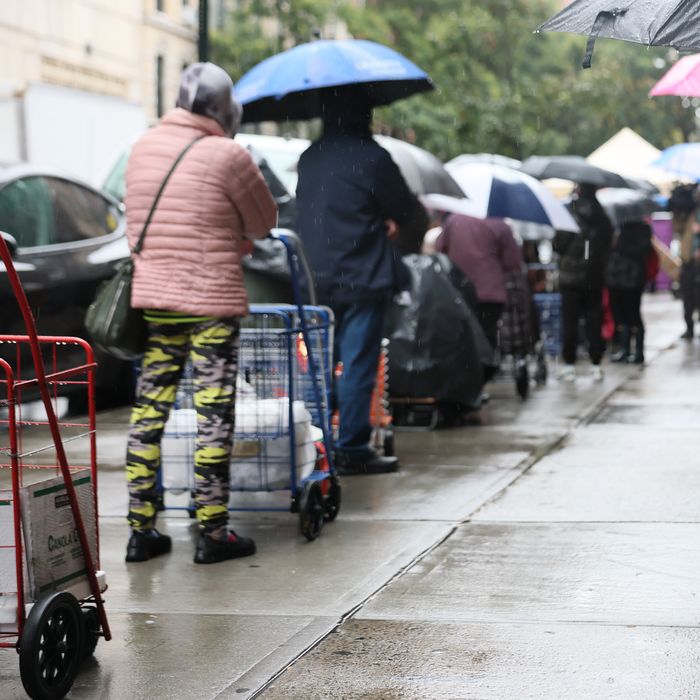
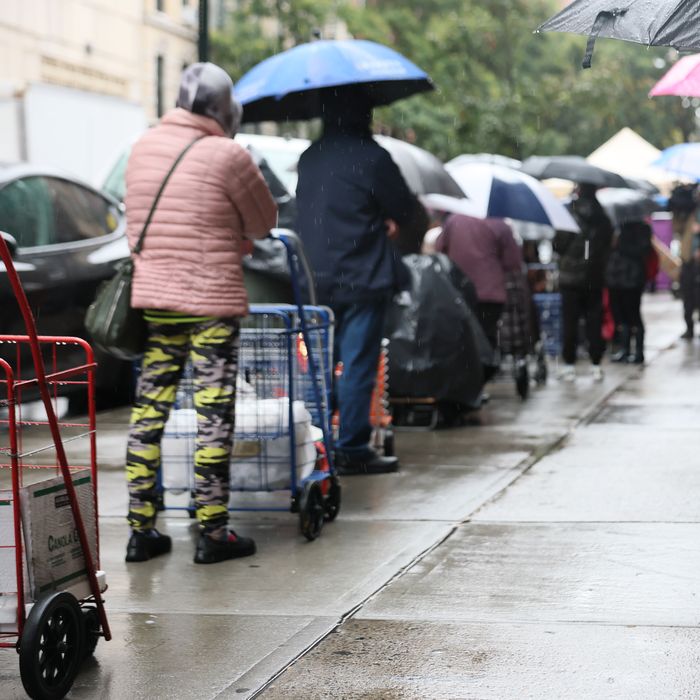
A line outside New York Common Pantry last fall. At pantries across the city, long queues have become more common. Photo: Michael M. Santiago/Getty Images
One morning earlier this fall, I was walking along Ocean Parkway when I noticed a line of people stretching nearly a block long. Some stood, others rested on the stone benches that dot the service road’s grassy median. Nearly all had granny carts and reusable shopping bags in tow, waiting for their turn to enter the food pantry housed in a neighborhood church. I’ve lived in New York for more than 20 years; coming across a food-pantry line is nothing new. But this was by far the longest line — for any food — I’d ever seen.
The city, of course, is overrun with lines, but the food-pantry lines are vastly different than the queues of people waiting for frozen yogurt and croissants. “It’s really a tale of two cities,” says David Greenfield, the CEO and executive director of the poverty-fighting organization Met Council. “You have folks who can drop hundreds on a meal at a restaurant, and at the same time, you have people waiting an hour on line to get their basic food needs met.”
The city’s contemporary food-assistance network emerged during the era of urban upheaval in the 1960s and ’70s and expanded significantly in the 1980s in response to Reagan-era cuts to the social safety net. While the wealth gap today has expanded and the cost of living keeps rising, the most significant contribution to the current needs arrived in July 2025, when President Trump signed the so-called One Big Beautiful Bill into law. That bill cut tens of millions of dollars of federal money allocated to New York pantries and soup kitchens to purchase food and changed work-reporting requirements to SNAP, effectively kicking 26,500 New York City residents off their benefits. “All at once, the supply of emergency food got more limited than in the past, while the need grew,” explains Siddhartha Sanchez, the executive director of the Mayor’s Office of Food Policy.
Many of the people recently removed from SNAP — seniors living on fixed incomes, single parents working multiple minimum-wage jobs, college students — are now arriving at food pantries for the first time. “We went from serving 750 households a week in April and May of 2026 to 1,500 a week now,” says Peter Endriss, the executive director of CHiPS, an emergency food provider and transitional residence in Brooklyn. “People start to panic about whether there will be enough food and will they still get served.”
Michael Ottley, the COO at Holy Apostles Soup Kitchen in Manhattan, has also noticed an uptick in anxiety among guests. Holy Apostles’ pantry uses a registration system, which means everyone on line already has an appointment and the pantry knows how much food to stock. But, Ottley explains, people still start to show up three hours before the doors open: “They’ll tie their shopping carts to the gate or fence and wait because of the generalized insecurity around availability.”
This sense of panic is not unfounded: Pantries and soup kitchens were designed to bridge an individual or family’s meal gap in a given month. New Yorkers are increasingly relying on them for everyday food needs in a way that has overwhelmed the system. “We are no longer emergency feeding — we are just feeding. It is an unfortunate new reality,” says Endriss. With further changes from the One Big Beautiful Bill set to roll out in 2027, including increasing states’ share of SNAP-related administrative costs, resources are likely to get more strained.
“The challenges we are facing now are unprecedented because the federal government is not meeting the moment,” Greenfield says. Giving up is not an option. As Ottley puts it, “We don’t close for nothing.” Instead, pantries have found ways to pivot and created systems to make their work more agile and impactful.
Earlier this year, Mayor Mamdani, along with the City Council, allocated $78 million for food distribution in 2027, tripling previously allocated amounts. This week, the mayor’s office also announced it had negotiated a 90-day delay on enforcement of increased SNAP restrictions at bodegas, and it initiated a massive outreach campaign to assist New Yorkers navigating the onerous new paperwork needed to retain their SNAP benefits. “We were able to successfully help 98 percent of folks about to lose their benefits,” Sanchez says.
Other changes help better manage how food is allocated and distributed: Holy Apostles switched to a touchscreen kiosk system that gives visitors more choice than prepacked pantry bags can — “When we moved to the SmartChoice kiosks, all the waste went away,” Ottley says — and Met Council has even turned to experimental AI-powered tools: “We can overlay things like usage-data trends at a food pantry with data about how many people have lost SNAP benefits in a neighborhood, or unemployment data, or neighborhoods where food costs are particularly high,” Greenfield says. The community profiles generated from the data enable Met Council to be more precise in how much food it dispatches to each pantry.
Ottley, who is a graduate of the Culinary Institute of America and worked for years as an executive chef before joining Holy Apostles 19 years ago, also reinforces the importance of organizations like City Harvest that redirect unused food from restaurants, grocery stores, and Greenmarkets to pantries and soup kitchens. “There’s not a donation that we turn down within reason,” he says. Meanwhile, as much as the city’s food pantries and soup kitchens have looked to innovate, they also continue to rely on an old standby to keep their systems humming: volunteers. “Our community — the seriousness of our volunteers and how protective they are of the organization — is remarkable,” Endriss says. “It carries me through what I see as a dark time in our national story.”