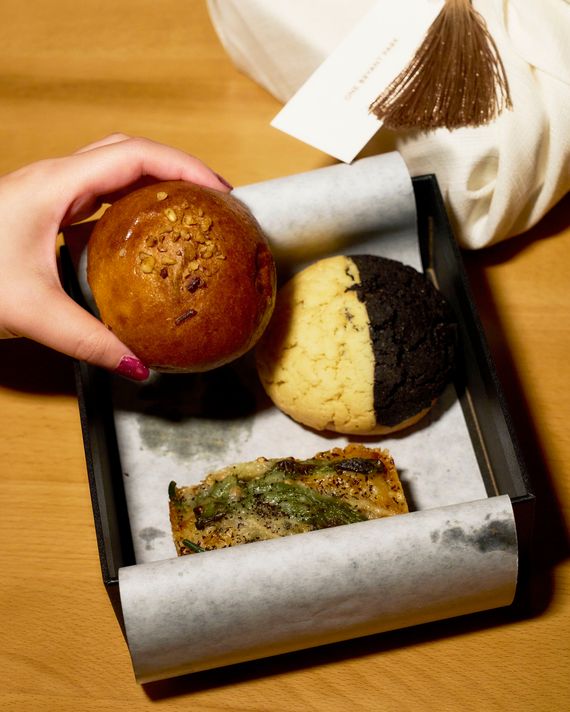
Guests at One Bryant Park are sent home with this trio of individual loaves. Photo: Hachikin Creative
Bread is a basic staple in many parts of the world, but it can still cause a fuss. Martin Auer’s $60 loaves of sourdough rye might be the most talked-about food of the year; bagels are launching zillion-dollar international empires; great bakeries are rising, while others are falling; and next, a talented industry vet is getting a chance to break out.
Bread is not traditionally part of kaiseki, the multicourse Japanese meal showcasing seasonal ingredients and five “essential” cooking techniques: raw, simmering, grilling, steaming, and frying. There is no baking. But Japan is a country that has revolutionized the discipline with its ethereally fluffy shokupans, salt-crusted shio pans, prize-winning pizza doughs, and more. So at One Bryant Park, which opens October 15, the innovations continue in a uniquely ambitious bread basket that will feature individual loaves of kabocha brioche à tête, sesame ginger raisin pain d’epi, koji petit baguette, a scallion-poppy seed cube, and — coming soon after opening — a seaweed naruto croissant.
The bread program also includes a signature loaf baked in an individual clay vessel, made with a blend of stone-ground whole wheat and Hokkaido brown mochi rice, served with komekouji-laced butter. The restaurant will also give diners a parting gift box holding a walnut-and-red-bean-stuffed anpan, a black-and-white melon pan that nods to New York’s famous cookie, and a mini buckwheat focaccia topped with shishito peppers.
All of this, and it is a lot, is the work of One Bryant Park’s in-house baker, Daichi Ebato, who will work alongside culinary director Tadaaki Ishikazi and executive chef Shuji Furukawa. The bread course is part of each of the restaurant’s kaiseki menus — five courses for $175 per person or 11 courses for $265 — and Ebato, who was born in New York, is using his recipes as a means to explore his Japanese American heritage.
“Being Japanese American was always a big part of my identity,” says Ebato, who credits family members who are involved in Asian American activism and politics. Ebato also hails from a family of artists: His mother, whom he credits much of his inspiration from, is the visual artist Akemi Takeda. His brother is the musician, artist, and poet Taiyo Ebato. Ebato fell in love with cooking during college while working at a Japanese restaurant. He enrolled at the now-closed French Culinary Institute, where the bread-baking program set him on a path that would lead to 17-plus years in the industry, with stops that include Runner & Stone, Hot Bread Kitchen, Daniel Boulud’s Dinex, ALF Bakery, the Japanese chain I’m donut ? in Times Square, and — of course — Le Pain Quotidien.
Ebato is putting all of that training to work at One Bryant Park, where he is blending his training in European-style bread techniques with his reverence for Japanese ingredients. A mochi rice bread is the clearest expression of Ebato’s thinking: Developed in collaboration with chef Ishikazi, it’s a porridge bread using mochi rice, giving the crumb a uniquely moist and squishy interior. The rice is incorporated into the dough in unusually generous quantities, creating something that sits deliberately between two worlds: “I really wanted that perfect balance of ‘It’s bread but it’s also rice,’” Ebato says.
The rest of the bread basket, in keeping with kaiseki tradition, highlights seasonal Japanese ingredients, such as kabocha squash. The challenge, says Ebato, is to find what works best as a complement to a kaiseki meal. His koji petit baguette uses rice inoculated with koji spores. After fermentation, the koji naturally converts starches into sugars. He roasts the prepared koji until it becomes deeply toasted and aromatic, then adds it as a dry, porridgelike inclusion in the baguette dough. The result is a deceptively simple, umami-forward loaf.
Rather than replacing rice or noodles completely, these breads provide additional small bites of carbohydrates much like rice and noodles would in a typical kaiseki meal. It serves as an apt precursor for a nontraditional (and luxurious) kaiseki menu that might include dry-aged Wagyu beef jerky and guinea fowl prepared four ways, utilizing the whole bird.
One Bryant Park will incorporate three separate dining rooms in the sprawling 10,000-square-foot floor: Kumiko Room is a 14-seat sushi counter helmed by veteran chef Yoshihiko Kousaka, and Kappo Sono is a relocation of the formerly East Village–based kaiseki restaurant of the same name from chef Chikara Sono. The largest dining space, called One Bryant Park, is the most avant-garde of the three. With Ebato’s bread basket, diners will get their first taste of what that entails.