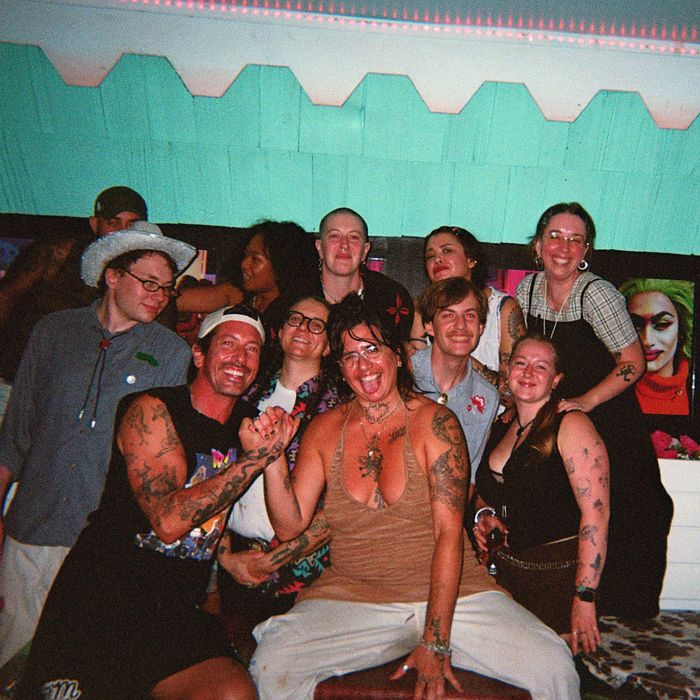
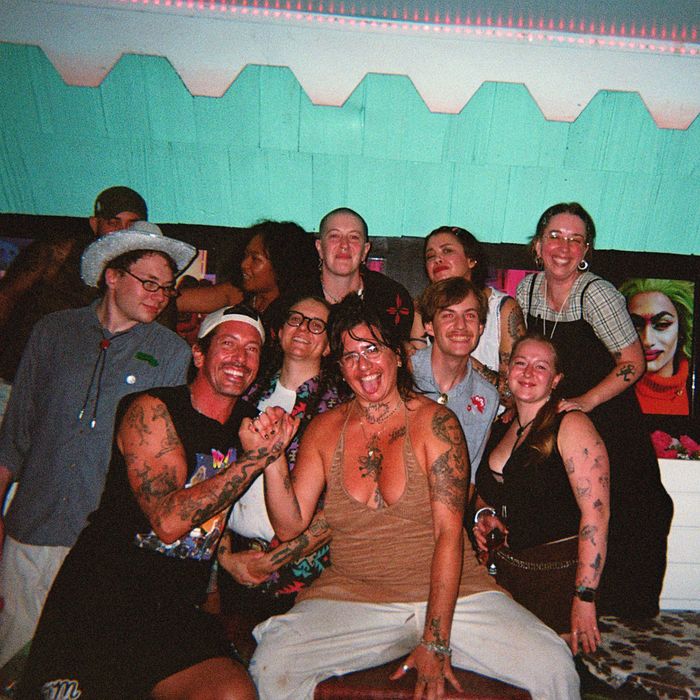
Halo Kaya Perez-Gallardo (front center) at Lil’ Deb’s Oasis. Photo: Lil’ Deb’s Oasis
Lil’ Deb’s Oasis in Hudson is the rare small-town restaurant famous enough to earn its own Wikipedia page, where it’s described as “an interactive art project, performance venue, and community gathering space.” Its co-founder, creative director, and owner, Halo Kaya Perez-Gallardo, calls it a place where they can do whatever they want: A “Ceasefire Now” yard sign hangs in its window, a community fridge is located next to the accessible entrance, Narcan is kept in the bathroom, and diners pay 77 cents on every check so Perez-Gallardo can make a monthly payment to the Stockbridge-Munsee Band of Mohicans for “operating on their stolen land.” On a recent night, customers were ordering tomatoes and cucumbers served in pools of roasted peach jam, along with fat triangles of scallion cornbread slathered in Calabrian-chile butter, and picking the meat clean from whole fried fish. Lately, new T-shirts have arrived. They read “Thank you! I love you! I’m sorry! Lil Debs Oasis/2016–2026.”
The restaurant got its start ten years ago when Hudson was known for self-serious, New American farm-to-table restaurants. Perez-Gallardo and co-founder Hannah Black — who had worked at Mission Chinese Food and Hartwood in Tulum and liked Hudson because it was a place where “life was cheap, rent was 400 bucks, you didn’t have to work that much” — were art-school grads who turned to food after finding the art world could be isolating. Black had accepted an invitation to run an Etsy co-founder’s Vietnamese-inspired food truck and needed help. She called on Perez-Gallardo, who grew up in Queens and attributes their “bizarre palate” to their macrobiotic mom and Ecuadorean immigrant grandmother. Their grandmother worked as a private chef for Donald and Susan Newhouse, who ate some of her Ecuadorean dishes but mostly wanted ’80s and ’90s-style magazine food, gefilte fish, and matzo-ball soup. (Perez-Gallardo remembers helping their grandmother on special occasions, poaching pears in red wine and serving paella with lobster.) Perez-Gallardo agreed to try the truck for one day and says that time working together was like “all the romance novels where there’s birds flying overhead and singing songs.” The truck eventually closed, but their partnership took off. They cooked at events around the Hudson Valley and once drove to Miami with their equipment strapped to the roof for a week of events during Art Basel.
But back in Hudson, they had a problem: There was no place to eat on Tuesday nights, when the town would practically shut down. They began hosting pop-ups at the local greasy spoon, Debbie’s Lil’ Restaurant, hanging up art, stringing lights, and filling Hudson’s midweek dining void. Five months later, owner Debbie Fierro decided it was time to retire; she asked if they wanted to take over.
They painted the outside pink and teal, artist friends handmade much of the décor, and in honor of Fierro, they named the new spot Lil Deb’s Oasis. Their hope was to create just that — an oasis — for their artist friends; they were inspired by Gordon Matta-Clark’s Food. “We wanted a place for the weirdos and the freaks,” Perez-Gallardo says.
Wheeler Brown, who would go on to become general manager, was a Bard student working at another restaurant in town when he visited Deb’s a month after it opened. He emailed them on the way home to ask for a job, drawn to the idea that “I could be with cool, hot young people in a cool, hot place,” he says. “What drew me to Deb’s in the beginning, what kept me in Deb’s for so long, and what made it explode was when you were there, the vibe was the fun field-trip group that you see across the museum and you’re like, ‘God, they’re having so much fun.’”
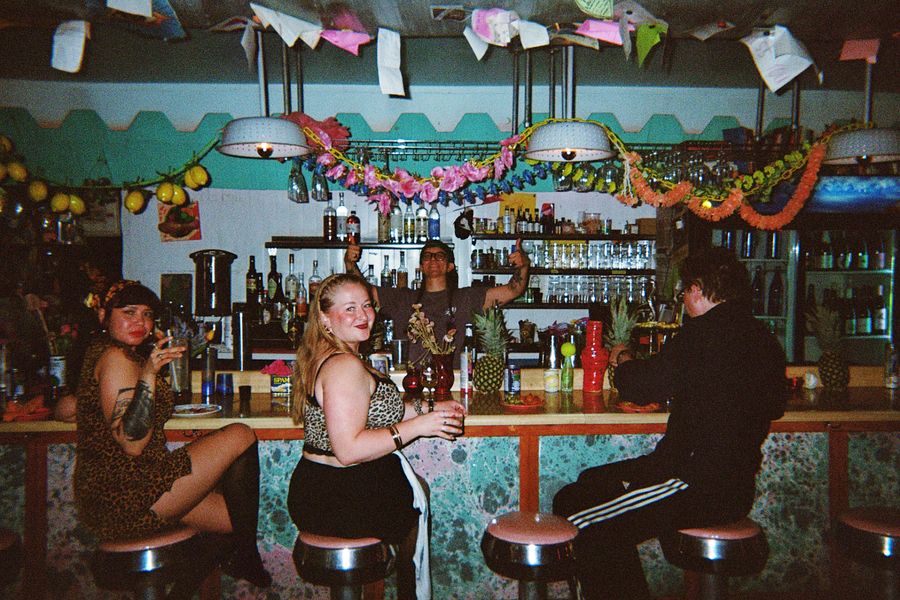
Photo: Lil’ Deb’s Oasis
Nobody intended for it to become a queer destination specifically, but Lil’ Deb’s quickly became one anyway, hosting events including monthly queer performance nights that brought out artists from across the Hudson Valley. The first was a honky-tonk. “It really felt like everyone in that little fucking city was in that restaurant,” says Ále Campos, a bartender and server. “I remember the countertop at the bar almost broke because people were sitting and stacked in every nook and cranny of that space.” The first time they made $1,000 in a night, they were like, Holy shit. When that became the norm, they would only celebrate a “twoser.” Still, previous patrons of Fierro’s version of the restaurant weren’t always taken with the new direction. After a customer left a three-star Yelp review that read “food was ok, environment weird ( if u gay perfect) people on the counter hugging being very touchy touchy that was weird to see,” Lil’ Deb’s turned the complaint into tank tops and bumper stickers emblazoned with “if u gay, perfect.”
Perez-Gallardo estimates that around 90 percent of the 200 people who worked at Lil’ Deb’s over the years were gay. But Lil’ Deb’s was for everyone. Seth Lachterman, 78, had a habit of taking long late-night walks around town while recovering from surgery. One night, he wandered into Deb’s, trying — and quickly loving — llapingacho. He would sometimes come back twice in a week, dragging his skeptical friends. Charlotte Benbeniste, a regular for five years, says Deb’s is “the place I always want to be. Sometimes you don’t want to eat a squash braised in an apple. In the dead of winter, it’s pretty nice to have a plantain on some cilantro-y yogurt.”
Like everyone else, the restaurant struggled and pivoted through the pandemic, and Black eventually left in 2021. “I don’t think anyone can keep giving that much of themselves to strangers every night forever — at least, I couldn’t — but I gave it six good years,” she says. “I don’t think we ever really learned how to separate the work from the people making it, and maybe that’s why it felt so alive. Maybe that’s also why it became so hard for me to sustain.” She says she felt like the restaurant demanded constant attrition, calling it “a fragile business that always needs to be tweaked and optimized. Costs must be cut, but how do you streamline heart and soul?”
Today, Perez-Gallardo acknowledges that “we’ve become expensive the more that I’ve had to center financial stability.” They always strived to make the restaurant a spot equally suited for a simple weeknight meal and a splashy celebration, but it was difficult to consistently hit both notes. Hudson has changed, too. In the beginning, everyone lived in town and walked to work. Now, priced-out employees commute nearly an hour by car. Perez-Gallardo is planning to return to school to get an M.F.A. They’d hoped to transition Lil’ Deb’s to another owner or turn it over to staff as a co-op, but the plan fell apart when the local nonprofit assisting with the transition pulled out; the landlord had put the building up for sale. That left no other choice, and after a season of homecomings for past chefs and an end-of-life block party, the restaurant’s final night is set for October 12.
“I don’t think that what the people are wanting right now is unbridled, maximalist fun,” says Brown. But Lil’ Deb’s lives on in other ways: Campos has since moved to Chicago and sees customers in the restaurant where he now works wearing Lil’ Deb’s merch. Telly Justice, who runs HAGS in the city, is one of the many restaurateurs who cite Lil’ Deb’s as an influence. Annie Bielski, an early server, floated the idea of a monument to Deb’s in Hudson (maybe a bronze plantain), and Perez-Gallardo has made peace with the end. “It just became about accepting that that’s not God’s plan right now,” they say. “For whatever reason, this project needs to die and it’s up to me to kill it.”
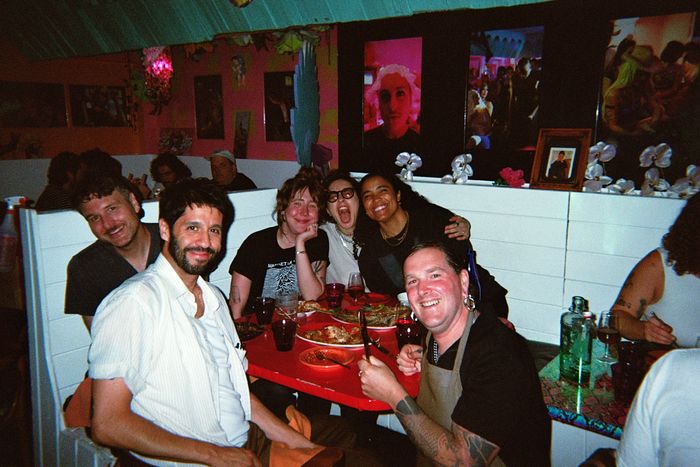
Photo: Lil’ Deb’s Oasis