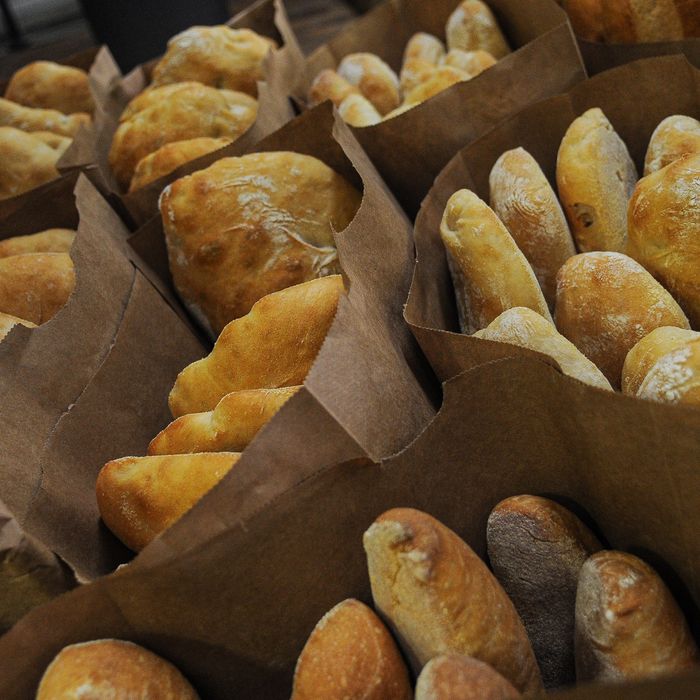
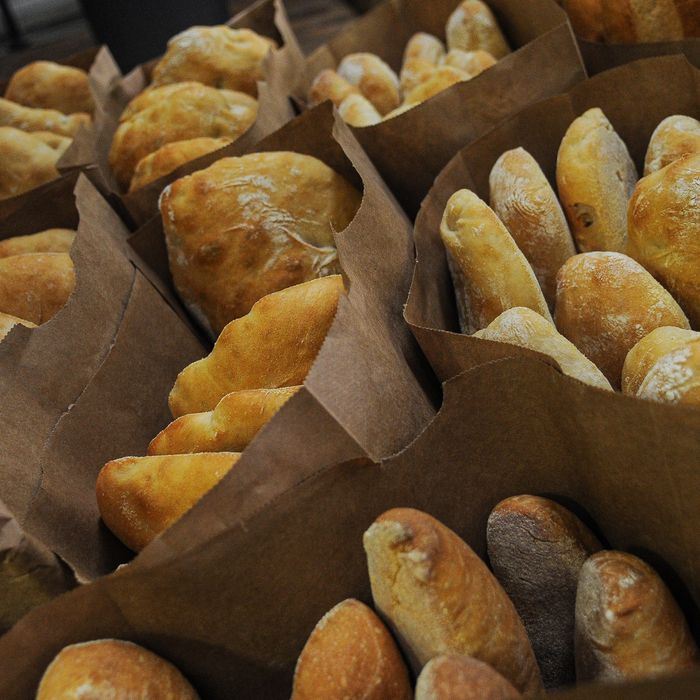
Bread from Caputo’s Bake Shop. Photo: Max Flatow
James Beard once said good bread is the most fundamentally satisfying of all foods. Caputo’s Bake Shop on Court Street, a 122-year-old Italian bastion of bread, was proof of that. Its chewy ciabatta rolls, twisted taralli, and black-and-white cookies ensured its Carroll Gardens neighbors were never in short supply of well-made baked goods. And like many who live in the area, I was shocked when this daily staple closed without warning.
The tributes have poured in throughout the week, but it has remained unclear why, exactly, James Caputo — the bakery’s fifth-generation owner — decided to close in the first place and why its shuttering came so suddenly. In talking to him, however, it becomes clear that the choice to close was not arrived at in haste; it was only when the bakery’s Italian-made Logiudice deck oven started to leak, literally, that he was able to come to terms with his long-simmering desire to take a break.
The oven is an annular steam-tube-powered system; a crucial tube broke and steam was escaping before making it into the chambers where the bread was baked, meaning the loaves wouldn’t rise. Over the years, water had deteriorated the compartment it was encased in, and the chamber was buried in concrete.
There was no easy fix, or any fix at all, unfortunately, because the oven is anchored into the building’s foundation — both structurally and sentimentally. “In the bottom of all that concrete is the steam generator, and the steam generator was shot,” Caputo explains. “To get to the generators and rebuild, we would have to be shut down for weeks.” In order to continue baking in the space, the family would have had to remove the decades-old oven and replace it with a bigger, better new one, an extremely costly endeavor. Margins are already tight, and beyond that, Caputo was ready for a change. “It was a totally personal decision,” he says. “We were squeaking by.”
Caputo’s closing didn’t come out of the blue for the family. “It had been discussed with my wife, mom, dad, and children for a very long time, but there was really no timeline,” Caputo tells me. Running the bakery took a toll on him both physically and mentally: “It got to a point where I needed to move forward, take the next step, and with three sons, I wouldn’t want this lifestyle for them.” He says the work was 24 hours a day, seven days a week. His phone rang throughout the night. “There was no rest for me, no off switch. It was so tumultuous that it was almost more stressful going away than being at work.”
Plenty of people expressed interest in taking over, but he didn’t want to sell outside the family: “If I didn’t rip the Band-Aid off — I’d be there until I die!” Understandably, he’s looking forward to taking some time off: “I want to live a normal life for a little while, while I can.”
Caputo’s biggest concern now is for his staff, many of whom have worked at the bakery for more years than even himself. He mentions Jose Motta, a.k.a. Joe, a manager who is like a brother to Caputo; Motta comes for Christmas dinner every year, and John Caputo, James’s father, was the best man in Joe’s wedding.
Natives of Palermo, the Caputo family immigrated to Brooklyn in the early 20th century, and in 1904, Caputo’s great-great-grandfather, Giovanni Caputo, opened the family bakery — originally in a small storefront at President and Hicks Streets. Shortly thereafter, he relocated it to Court Street in the Longshoremen’s Association, where it sat for 60 years until Caputo’s great-grandfather, also James, moved it across Court to its current location.
Caputo’s was famous among its fans for the variety of different breads it offered — “I had a couple hundred SKUs, that was kind of our trademark,” Caputo says — and the bakery’s lard bread, on offer since the beginning, became an icon of the place over the years. It was an iteration of pane con ciccioli, which is traditionally studded with pork renderings cooked down until they’re crunchy. “My favorite way to eat that bread was as soon as it came out of the oven — it burned my mouth!” Caputo says. “I do worry that I might not ever eat a lard bread again.”
Caputo also remained committed to making Sicilian breads, even though they were never a big seller. “I was losing money on them, but it was so important to my identity,” he says. Distinct from what we colloquially know as “Italian bread,” Caputo explains that Sicilian breads involve a much longer process to create, with a drier dough that bakes at a lower temperature than a baguette, for example, and without steam. The result is a very pale loaf with a cottony interior. (Caputo’s characteristic red-and-white twine, which hung from golden teardrop canisters from the ceiling, was pressed into the dough rather than slashing the tops with razors. As the dough proofed, the twine would leave its distinctive score marks.)
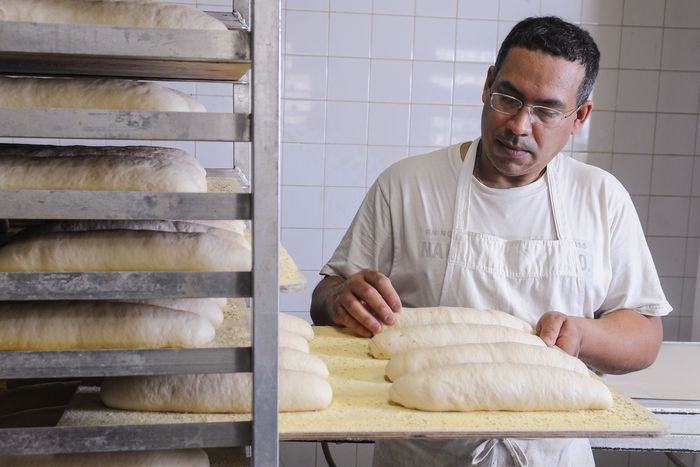
Preparing loaves. Photo: Max Flatow
In his 25-year tenure as owner, Caputo has extended the wholesale business across the borough and beyond, which had grown to include spots like Peter Luger, Noodle Pudding in Brooklyn Heights, and Sam’s Pizzeria just up the street — the first restaurant Caputo remembers going to. More recently, Court Street Grocers and the Meat Hook have purchased loads of loaves for their sandwiches. Stephen Young, the general manager at the Meat Hook’s Carroll Gardens location, grew up in Yonkers in an Italian American enclave. The original Williamsburg Meat Hook uses She Wolf bread for its sandwiches, but when Young expanded to Carroll Gardens store in 2024, he chose to buy Caputo’s bread, not just out of convenience (it’s around the corner from the bakery) but because it reminded him of the bread he grew up eating. “Buying from a small business — that’s community building,” Young says, “getting to know your butcher or your baker.”
The closing now leaves a hole in the neighborhood. Max Flatow, a food photographer who grew up on Sackett Street, notes that Caputo’s was the first place he was ever allowed to shop by himself. “I’d buy long chocolate-dipped sandwich cookies,” Flatow remembers. He hid them under his bed for a secret snack before going to sleep. “Any party, gathering, funeral, and celebration — a box of Caputo’s pastries were obligatory.”
A makeshift vigil has been established outside of the shop, with letters and drawings taped to the door and bouquets of flowers left on the ground. Inside, the terrazzo floors installed by Caputo’s grandfather are still visible. Even if the oven had been replaceable — a big if — Caputo’s is not.
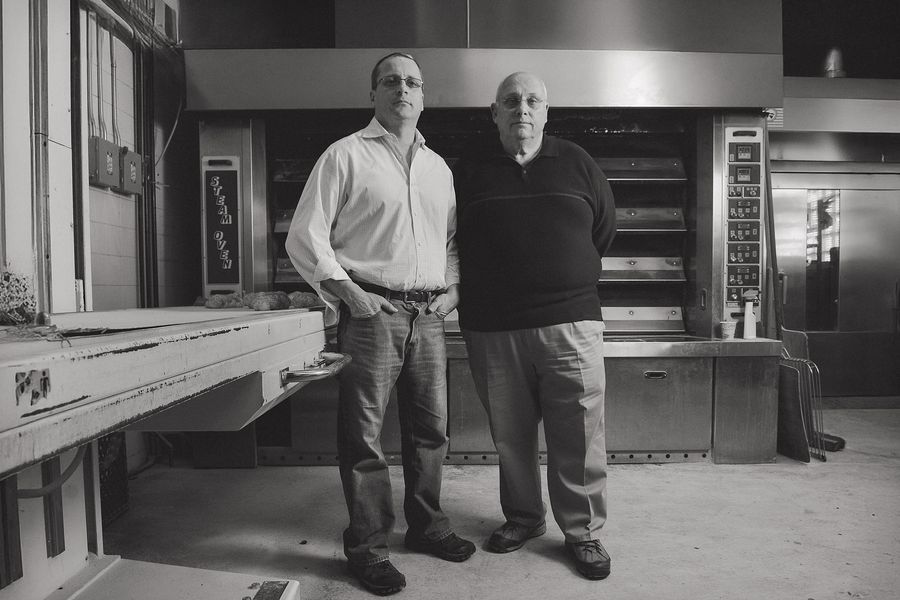
James Caputo, left, with his father, John. Photo: Max Flatow