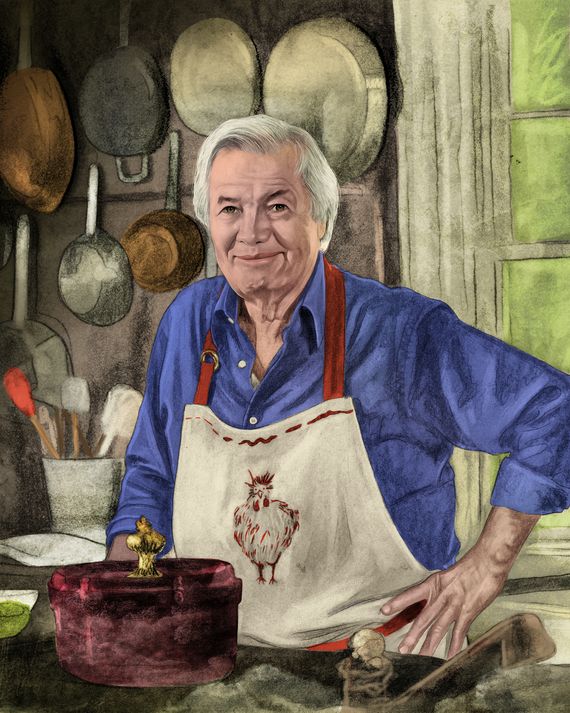
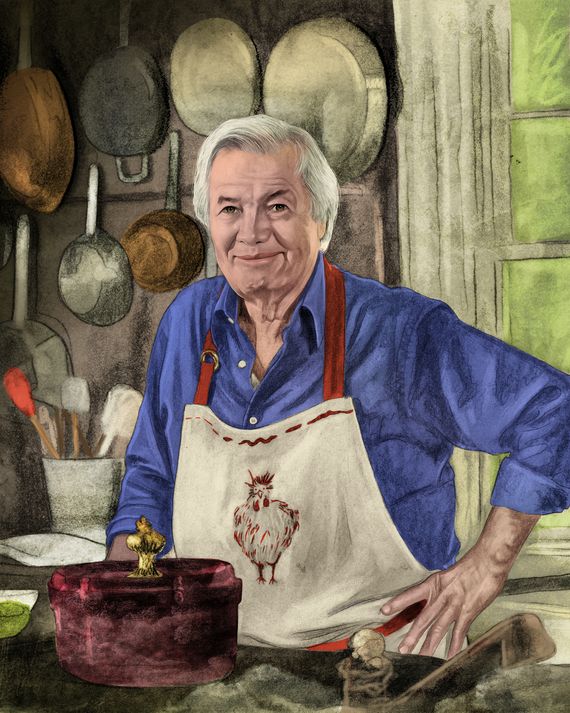
Illustration: Brian Lutz
The most delicious roast chicken I’ll ever eat came from a Stop & Shop near Madison, Connecticut, where the bird cost $12 raw. I took two bites of it in the back of an Uber and then burst into tears. The driver, who clucked his teeth rhythmically to the beat of a reggaeton song, didn’t ask what was happening. If he had, I would have told him that the only living being who could corroborate the quality of the chicken wrapped in a container, warm in my lap, is a black poodle named Gaston.
Gaston has the particularly good fortune to live with Jacques Pépin in a cozy house about 20 minutes by car from New Haven. Earlier in the day, Gaston greeted me with suspicion when I arrived at Pépin’s house. The chef, now 90, was already seated in his favorite chair at the kitchen island. He was wearing a black cable-knit sweater, tobacco-colored corduroys, and house slippers, and he gave me the same playful smile I’d seen punctuate clips from decades of TV shows instructing viewers to roast a leg of lamb or shingle a potato gratin. Gaston completed his assessment of my tote bag and curled up several feet away in a plush bed to monitor the situation.
I had gone to Pépin’s house with a simple assignment: To question a chef who has taught — and this is a conservative guess — millions of Americans how to cook about the best way to roast a chicken. On this day, we would attempt the Bresse-born Pépin’s preferred method, from the recently published 50th-anniversary edition of his Complete Techniques. Pépin’s assistant had called the day before with firm instructions: Because, at his age, it is painful and onerous to stand for too long, he was to stay seated while I did the heavy lifting. I was also warned that Pépin might resist this arrangement but told I should do everything in my power to keep him in that chair.
So I began to chop the garlic. Pépin’s recipe for poulet farci sous la peau, or chicken stuffed under the skin, calls for two cloves, crushed and minced. Behind him, nearly six dozen skillets and saucepans hung from a wooden wall; the tableau fits a certain mythological image of the chef at 90, living in the country with a little dog. His kitchen looked just like the images online, with a wood-paneled refrigerator and tilework. Terra-cotta-colored walls open into the living room, lined with his paintings, where the BBC played on mute. And he had that familiar smile — though I noticed it disappeared when I asked about anything other than ingredients or technique. It slipped from his face completely when I asked whether “the best roast chicken” is even a conceptual possibility. Pépin said no; “the best” is a relative matter, he insisted, and your definition of the best of anything is “to a certain extent a narcissistic reflection of your taste.”
I used the blade to flatten the cloves, feeling his gaze on my hands. Suddenly, he was beside me. “Not like that; it isn’t crushed enough,” he said. His assistant looked up from her laptop across the room as Pépin took the blade from my hands and pressed it firmly into the collapsed clove. “To release more of the essential oils,” he said before deftly mincing the cloves. I sliced the mushrooms, which I would sauté and stuff beneath the skin of the chicken. He stepped in again, correcting my knifework, demonstrating how the blade should move like a wave breaking on the sand, its front arriving before its back. With no cameras filming, he was more brusque than the Pépin I had watched on television, less mischievous and more firm, matter of fact. The backs of his hands were pale and snaked with veins, and he minced with 15 times the authority I had mustered.
After several awkward encouragements, he finally agreed to sit again, and I probed him about his history with roast chicken. Every man remembers his first bird. For Pépin, it was when he was about 7 and it was summer in Bourg-en-Bresse. He was out trawling with his two brothers in wartime France when they came across a chicken that had escaped its coop. Hungry, the boys captured the animal and encased it in clay to roast over coals while they swam in the river. He writes in Art of the Chicken — a collection of his chicken paintings, memories, and recipes — that the bird is his version of a Proustian madeleine, though it occurs to me that Proust never deboned several dozen dead madeleines per day as a line cook.
Pépin, who without warning was now once again standing beside me as I threw nervous and apologetic glances at his assistant, Kelsey, began to sauté the sliced mushrooms with garlic and parsley; he set it aside to cool. Next, he added a pat of butter to the dirtied skillet — not part of the recipe — and tossed in the giblets, searing them on all sides. Gaston, who had been asleep for an hour, peeked out over the lip of his bed. Pépin allowed me to feed him a piece of liver, and Gaston licked his lips happily, as though he’d begun to forgive my intrusion.
As I skinned and de-seeded tomatoes for the sauce, I asked Pépin what he believed had mattered, looking back on his life, as opposed to what he thought would have mattered. He said that things just happen, and also that I was being too precious with the tomato seeds. As he corrected my technique, he told me that he rejects the idea of building a life with intentionality. His has been one of chance: He was born terrifyingly early, weighing two and a half pounds, on the brink of World War II. He became the private chef of French president Charles de Gaulle only because he was doing a mandatory military stint. He met his wife not in any of the kitchens or dining rooms one might expect, but on the ski slopes of the Catskills, where he temporarily worked as an instructor. When his daughter was small, he got into a terrible car accident while commuting home when he swerved to avoid a deer; he was told he would never walk again and spent weeks in a semi-conscious state. When he woke, he had to abandon his career as a “chef” and instead become a culinary educator. In the intervening decades, he has authored more than 30 books and collected a comical number of James Beard awards, and today he sits at the helm of a foundation that promotes nonprofit culinary training and has donated more than $2 million. He has his own brand of caviar. But all of this came about, Pépin said, because of convenience: “My mother was a cook, my father was a cabinet-maker, and I liked cooking better.”
He changed the subject a bit gruffly: “Do you know how to remove a wishbone?” It was time to prepare the chicken. I nodded “yes,” lying (I always leave it in), and so the first time I used a paring knife to delicately expatriate a wishbone from the breast of a chicken, Jacques Pépin watched, a little bored. Then he was beside me again, helping me to guide the paring knife into the bird on either flank, making slits above and below each side of the bone. He instructed me to reach in, grab the center, and wiggle it loose like a tooth. I yanked the bone from the bird in one piece and we set it aside to dry. One of Pépin’s painted chickens, a particularly foppish model, seemed to be glaring at me from a living-room wall.
I separated the chicken’s skin from its flesh as Pépin watched. I spooned the seasoned mushroom mixture beneath the skin. Still on his feet — I was mouthing “sorry” at Kelsey — the chef offered to show me his trussing technique. By the time he was finished, the bird was almost spherical, its limbs tucked beneath plump breasts. Pépin browned it all over (also not in the recipe; he maintains that even in a restaurant, if he made a chicken 25 times, he would each time cook it differently according to the chicken). He set it on its side, rather than on its back, a technique he likes because it allows the bird to self-baste as its fat renders down toward the skillet. Finally, he sat back down.
While it roasted, I was released to wander through the house. My sense that I was a slightly unwelcome visitor — one agreed to in a hasty exchange with a PR person, perhaps — had me moving slowly, so Pépin could sit in silence and peace. Downstairs, the walls were crammed with memories; images covered every surface. I examined a black-and-white photograph of Pépin in a tuxedo beside Julia Child and a portrait of his wife, Gloria Evelyn Augier, who lived with Pépin in this house for almost 50 years before she died in 2020. She was standing beside a white horse, one hand on its neck, her face frozen in an elegant, challenging expression.
Upstairs, in the chef’s office, I tried to identify the book he had told me earlier he’d cribbed while working as a chef at Plaza Athénée; perhaps it was that tattered edition of Voltaire’s Lettres Philosophiques? I gave up and admired the many volumes about cheese. On the easel was a geometric abstraction in shades of navy and turquoise; several more were tucked into the French blue-shelves. Downstairs, I found records of decades of dinner parties past. They had been committed to history via handwritten, illustrated menus in leatherbound sketchbooks, and they betrayed a cheerful tenderness I realized I had been grasping for in person: lists of “les invités” scrawled in sloping cursive, a careful record of bottles consumed — Capa Lapostolle 1994, after a toast with Moët & Chandon (Pépin is, famously, not a wine snob) — and whimsical watercolors of tiny bananas, a smiling quail, a jaunty pink prawn.
Back in the kitchen, Pépin was already working on the sauce for the chicken, tomato cooked in schmaltz. He’d seen me looking through the books of menus and told me, “My whole life is in there.” Recently, his daughter, Claudine, asked what they made for her 5th birthday, and he’d opened one of the volumes to find a tiny drawing of a chicken. Now, he was tracking her location on his phone; she was on her way over. Kelsey reminded him again he had better be seated by the time she arrived.
Food, he told me, is not as pleasurable for him as it was once. Painting is. Doctors have him watching his salt. Still, he grinned describing a passage in a forthcoming book by the chef Patrick O’Connell in which its narrator so thoroughly enjoys a piece of ripe fruit, just as a vibrating train passes beneath, him that he ejaculates.
The wishbone had dried, so we each took a half and pulled. I got the larger half, but we didn’t dwell on it because the chicken was ready — just as Claudine, her husband, Rollie, and their dog tumbled noisily into the house, greeting Gaston and bringing with them a container of pasta alle vongole (Gloria’s recipe).
I tried to say my good-byes. I’d been told that when his family arrived, I should scram, but Pépin wouldn’t let me go without trying his bird, almost despite himself. He was discouraged from doing the same, as vongole waited, but he stood again to carve the chicken and then watched eagerly, almost animated — a different person entirely than the one I’d spent the day with — as I sliced into a breast. I took a bite and told him the truth: It was perfect. He said he usually prefers the leg. I tried that next, spearing a slice of meat and skin and running it through the tomato sauce spangled with olives. I told Pépin that it was even better than the breast. I was handed a plastic container with the rest of the chicken wrapped tightly in clingfilm and he asked how I’d get home. I told him I had a train booked and had called an Uber to the station. This seemed to satisfy him, and he said his good-byes, quiet again. I walked through the house to leave and when I reached the driveway, I turned, sensing someone behind me — probably Gaston. It was Pépin, watching from the entryway. In the face of everyone’s protestations, he had insisted on walking me out. Getting into the car, I saw him standing there through the doorway, and I didn’t exactly understand why he had gotten up to watch me go.