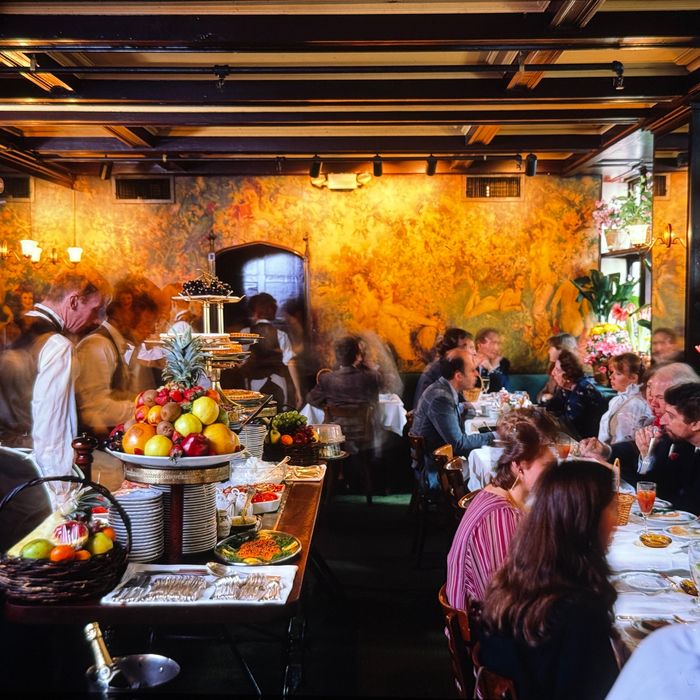
Café des Artistes, ca. 1999. Photo: Mick Hales
When Ariel Arce was growing up, her parents were such fans of Café des Artistes on the Upper West Side that she had her high-school graduation lunch there. The restaurant closed in 2009, but Arce and her business partner, Max Katzenberg, will reopen it next year with a plan to re-create the place she remembers. “We want to honor that kind of old-world café feel — we are not downtown kids coming uptown and making a small-plates restaurant, that’s for sure,” she says. “The only way I would ever imagine going into that space is to try to revive the restaurant of my youth.” (The famous Howard Chandler Christy murals have been preserved.)
“We’re living in a time when everything feels so homogenized,” Arce points out. “These old places remind us of a more sophisticated New York City where people really built relationships with their customers and you saw familiar faces and it wasn’t just about checking off a box like ‘I’ve been there.’ ” When the revamped Café des Artistes opens, it will join a wave of new restaurants that are also very old restaurants. Across Central Park, on Lexington Avenue, Jon Neidich has leased the space that was home to Donohue’s Steak House, where he’ll court the old regulars with an as yet unnamed establishment opening in 2027. “I think a lot of them will come back and hopefully enjoy what we did,” he says. While he can’t use the old Donohue’s name, he can evoke the memories of being in that place: The wooden walls and black-and-white linoleum floor will be refurbished; there will be black vinyl booths on at least one side of the room, and the new bar will be where the old one stood. “My goal is for it to feel very similar,” he says.
In Brooklyn, the century-plus-old Sicilian sandwich shop Ferdinando’s Focacceria reopened this year as Bar Ferdinando under the guidance of the team that owns Swoony’s around the corner and Cafe Spaghetti across the street. Moving toward Atlantic, Georgia Fulton reopened Sam’s with the same name, façade, and décor, while Alex and Miles Pincus, owners of several bars in New York and New Orleans, assumed control of Montero Bar & Grill, where — aside from hanging up some compliance signs, accepting credit cards, making the pool table free, and starting a kitchen renovation so it can again produce food as it once did for decades — the new owners changed very little. “It’s fundamentally just an incredibly beautiful and authentic place, and it would be a shame for it to lose one ounce of its character,” Alex says. (Even places that don’t go full rehab can reap some of the benefits: The owners of Mamali, a café and bar that looks from the outside exactly like the Village Cigars shop it replaced, and Mash Inn, which co-opted the faux–Lannon-stone façade and corrugated-metal awning from the laundromat that previously occupied the space, say neighbors were happy to learn that the character of the businesses wasn’t changing entirely.)
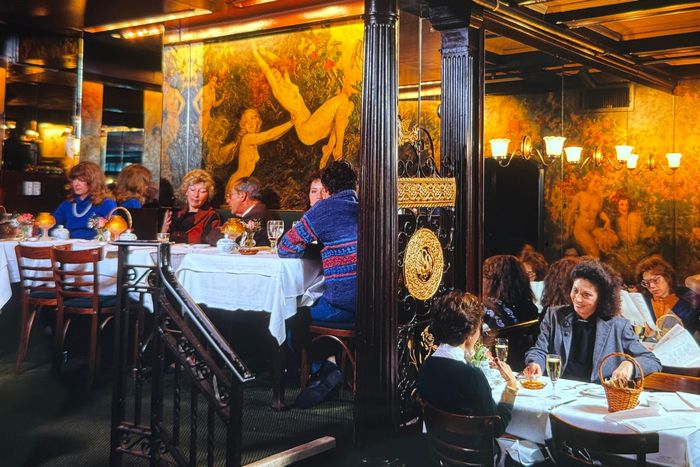
Café des Artiste’s dining room in 1984. Photo: Mick Hales
Montero’s, as it’s known to regulars, sits just a couple of blocks from the Long Island Bar. When it debuted in 2013, it helped to establish this “prehab” trend (see also Le Veau d’Or, Gage & Tollner, and S&P Lunch) of refreshing an old space to make it look like the best version of its former self: Owners Joel Tompkins and Toby Cecchini chose to keep the 1950s-era interior of what had been the Long Island Restaurant, even if most other operators might have been tempted to gut the place and start clean. “There was no sort of edict that we needed to keep it,” Cecchini says. He and Tompkins just decided to do so. “Everybody has that sort of craving for what they perceive as authenticity in whatever form that presents itself,” Cecchini adds. A place like Long Island Bar couldn’t be created, even with the help of talented designers, because, he says, they “couldn’t get the level of structural dilapidation.”
Cecchini drew inspiration from his first New York job at Keith McNally and Lynn Wagenknecht’s Odeon, which, in 1980, took over a space that had been an Automat. “They kept that room largely intact,” Cecchini says, “just effectively leaving it as is and saying, ‘This is brilliant. Let’s just get some era-specific tables in here and chairs and let this thing do its magic.’”
Similarly, Frank Buffa, the longtime owner of Ferdinando’s, made no demands on Sal Lamboglia when he asked the Cafe Spaghetti owner to take over the old restaurant. “When we walked around, it was kind of funny,” Lamboglia remembers. “He was like, ‘This is garbage. This one is shit.’” Buffa invited him to toss whatever he liked, but Lamboglia decided to keep much of the look. “It meant a lot for me to sort of keep that,” he says, “to keep the name going and to leave it up on the sign.”
Plus, isn’t it cheaper to keep something old than to start fresh? “No,” says Lamboglia, who redid Ferdinando’s entire electrical system. “We kept a lot of the paint and everything else. But in the walls, I mean, everything was kind of a mess.”
Fulton adds that, at Sam’s, a similarly timeworn space, “things will break, things will need to be brought to code. Things are old and fragile.” She says she had many conversations with Louis Migliaccio, the restaurant’s previous owner, “with him saying, ‘Oh, don’t change too much, and I’d be, ‘The whole point of me wanting this place is because I don’t want to change too much,’ you know, so it wasn’t a conflict anyway.”
That is the prevailing sentiment for each of these operators. “After the pandemic, you saw a hunger for nostalgia,” Neidich says, “and I think there was a moment when it felt like something you took for granted could actually be gone.” But while recapturing a bygone era is a major motivation behind all these projects, there’s a particular comfort now in saving spaces that have endured for decades. “With all the madness in the world,” Alex Pincus adds, “and, you know, the potential AI takeover, real things matter more than ever.”